
Two retail data centers extend Layer 2 with EVPN and VXLAN across the fabric. A MAC that should be learned on that overlay is missing. The core is not segment-routed, and there is no point-to-point wire. Where is the fault?
Select an answer to reveal the explanation.
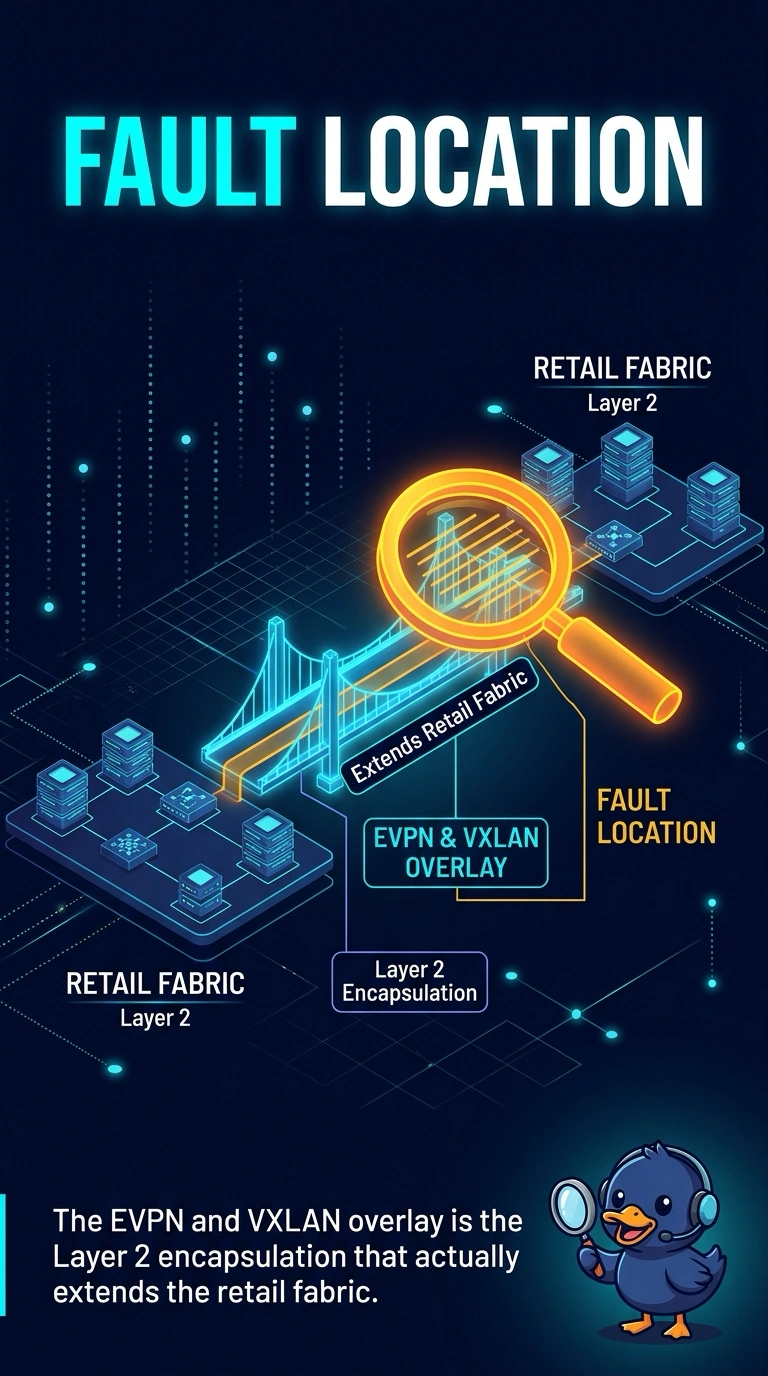
Short Explanation
A mechanic tests the road that was paved, not a bridge that exists only on another map. You look at the EVPN and VXLAN overlay where the missing MAC should have been learned. Segment-routed EVPN, an ACI fabric fault, and a pseudowire are encapsulations this path does not use.
Full Explanation
EVPN with VXLAN is the overlay that extends Layer 2 across this retail fabric, so a missing MAC belongs to the encapsulation actually in the path. MP-BGP EVPN Type 2 routes advertise remote MAC reachability. VXLAN carries the Ethernet data plane. Check local learning, advertisement, route-target import, and VNI mapping. EVPN carried over segment routing and MPLS fails by concept because that transport requires a segment-routed core with MPLS under the overlay, and this core is not segment-routed. An ACI policy or forwarding check fails by concept because ACI policy and endpoint learning exist only inside an ACI fabric, and this retailer does not operate one. A pseudowire fails by concept because it emulates a single point-to-point wire between one pair of sites, while this symptom is on a multipoint VXLAN overlay for many endpoints. Exam caveat: Match the symptom to the encapsulation actually in the path. Operational check: Confirm absence in EVPN tables and VXLAN VNI mapping on the retail fabric.