
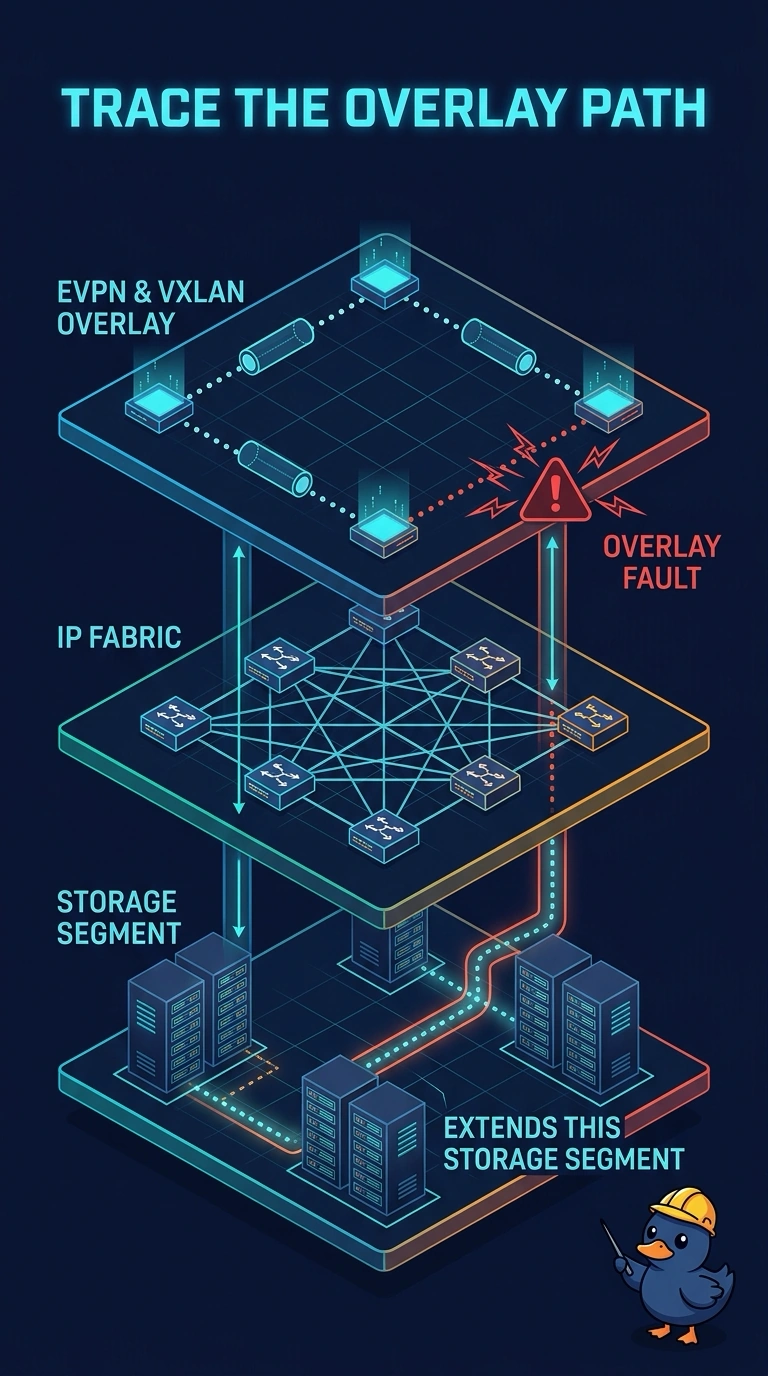
Two hospital data centers extend one storage segment across an IP fabric that carries VXLAN with an EVPN control plane, and a MAC learned at one site does not appear at the other. Which fault matches the encapsulation actually in the path?
Select an answer to reveal the explanation.
Short Explanation
Blaming the wrong road will not help you find a missing car. You inspect the EVPN and VXLAN overlay because that encapsulation is what actually carries the storage segment. A segment-routed MPLS core, an application policy fabric, and a point-to-point pseudowire are not the path in use.
Full Explanation
Data-center interconnect diagnosis starts from the encapsulation that is actually in the path. Here the sites extend a segment with EVPN control and VXLAN on an IP fabric. MP-BGP EVPN Type 2 routes advertise remote MAC reachability. VXLAN carries the Ethernet data plane. Check local learning, advertisement, route-target import, and VNI mapping. A segment-routed MPLS core, an application-centric policy fabric, and a pseudowire are different encapsulations and are not this path. An EVPN and VXLAN overlay fault on the IP fabric that actually extends this storage segment is the correct fault because that overlay is what carries the segment. An EVPN fault on a segment-routed MPLS core that is not the encapsulation of this fabric is the wrong fit because segment-routed MPLS would matter only if that transport carried the EVPN routes for this interconnect. An application-centric policy or forwarding fault inside a fabric that is not in this path is the wrong fit because that policy fabric is not in the path, and this path is VXLAN. A point-to-point pseudowire fault on an emulated circuit that is not carrying this segment is the wrong fit because a pseudowire only emulates one point-to-point circuit and does not extend a multipoint segment. Exam caveat: EVPN can ride VXLAN or a segment-routed MPLS core, so the control-plane name alone does not tell you the data-plane encapsulation to check.