
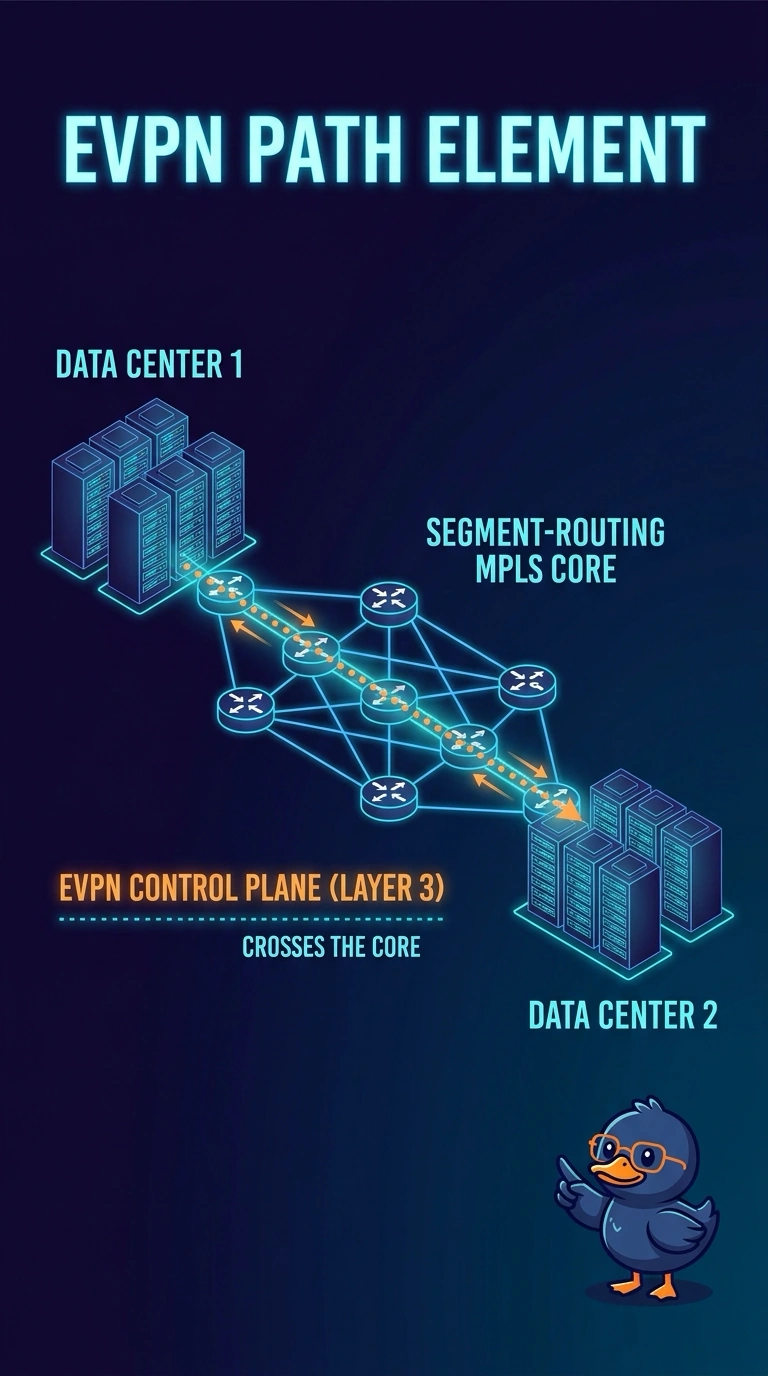
Two regional data centers extend a tenant Layer 3 service with EVPN across a segment-routing MPLS core. Routes from the far site stop arriving, but switching inside each building still works. Which path element matches?
Select an answer to reveal the explanation.
Short Explanation
A missing highway sign is a different problem from a broken street inside one town. You look at EVPN carried over the segment-routing MPLS core when far-site routes stop arriving. A local VXLAN overlay, an ACI fabric fault, and a pseudowire are different paths.
Full Explanation
EVPN over SR-MPLS is the inter-site control plane for this tenant Layer 3 service. Far-site routes have stopped arriving, so the fault follows MP-BGP EVPN peering and route exchange across the core between the two data centers. The EVPN control plane as it crosses the segment-routing MPLS core between the two data centers is therefore the matching path element. A VXLAN overlay between leaf switches that extends a subnet inside one of the two buildings is the wrong fit because it is an intra-building data-plane overlay, and local switching is still working. An ACI policy or forwarding fault in a fabric that carries the tenant between the two buildings is the wrong fit because this core is segment routing over MPLS, not an ACI fabric. A pseudowire that emulates a point-to-point circuit between one pair of provider routers is the wrong fit because it emulates a single point-to-point circuit, not EVPN route exchange. Operational check: Verify MP-BGP EVPN peering and route exchange, including route targets and next-hop reachability. If remote routes are present, check the separate SR-MPLS forwarding path and label stack. Local switching does not identify the cause of an absent remote route.