
A branch must reach a cloud virtual router across the public internet, and the traffic must be encrypted on that untrusted path. Which design meets the requirement?
Select an answer to reveal the explanation.
Short Explanation
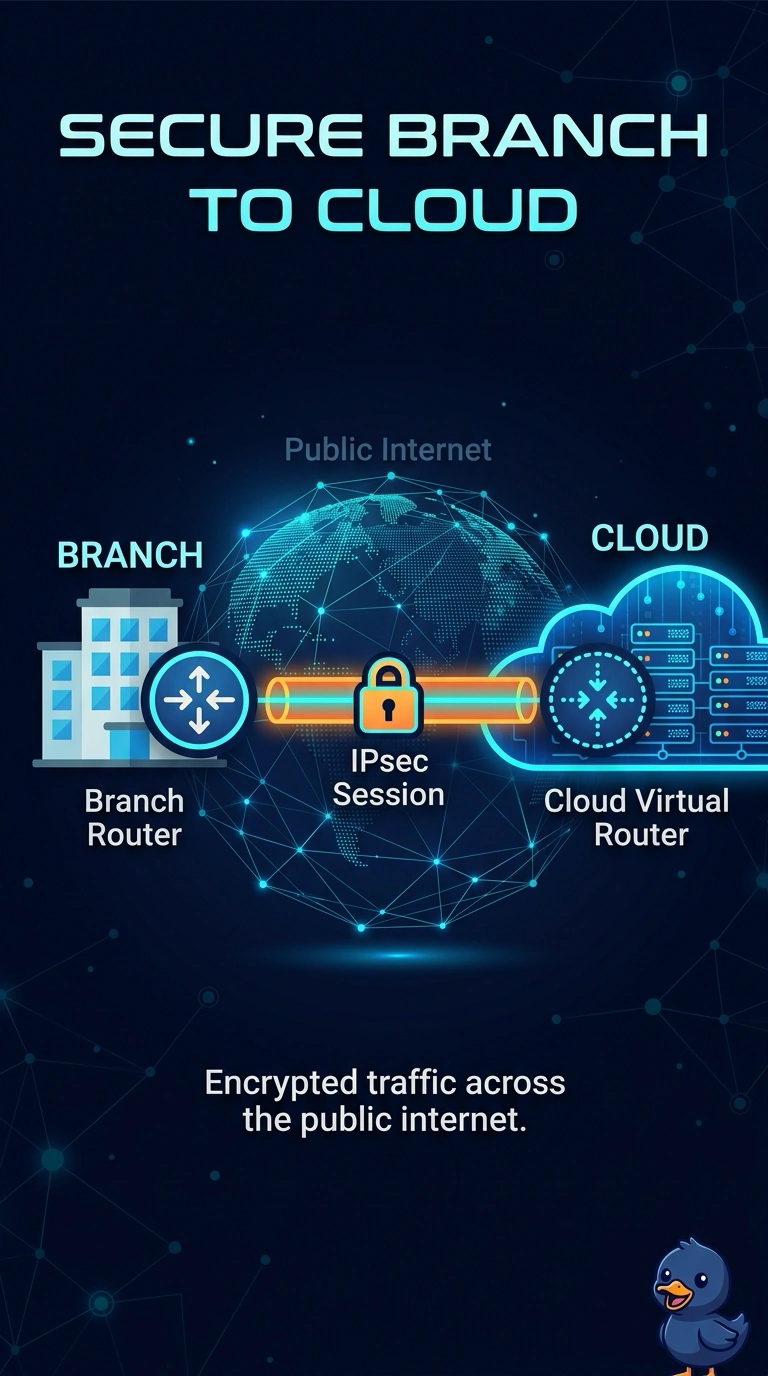
Think of the public internet as an untrusted road: you need encryption on the path to the cloud virtual router. You can use IPsec between the branch router and cloud virtual router to protect that traffic. A private interconnect, provider MPLS or segment routing, and GRE do not provide the required encryption on this public path.
Full Explanation
IPsec encrypts traffic between the branch router and the cloud virtual router when the path is the public internet, which is not a trusted private facility. A direct private interconnect from the branch facility into the cloud provider network provides a dedicated path, but it is not an encrypted tunnel by itself and does not meet the requirement to encrypt traffic on the public path. Provider MPLS or segment routing carries traffic as labeled provider transport; it steers traffic but does not encrypt packets on an untrusted internet path. A GRE tunnel from the branch router to the cloud virtual router across the public internet encapsulates packets, but encapsulation does not encrypt them. An IPsec session between the branch router and the cloud virtual router across the public internet therefore meets the requirement. Exam caveat: A private interconnect can meet a different requirement—a dedicated path—but it is not a substitute for encryption on this public path; neither provider MPLS or segment routing nor GRE adds encryption. Practical check: Confirm that the branch router and cloud virtual router negotiate IPsec and that traffic crossing the public internet is encrypted.