
A manufacturer sees product-launch day traffic that does not resemble an ordinary weekday and must decide whether that day is an incident. What should the team compare the launch-day traffic with before calling it an incident?
Select an answer to reveal the explanation.
Short Explanation
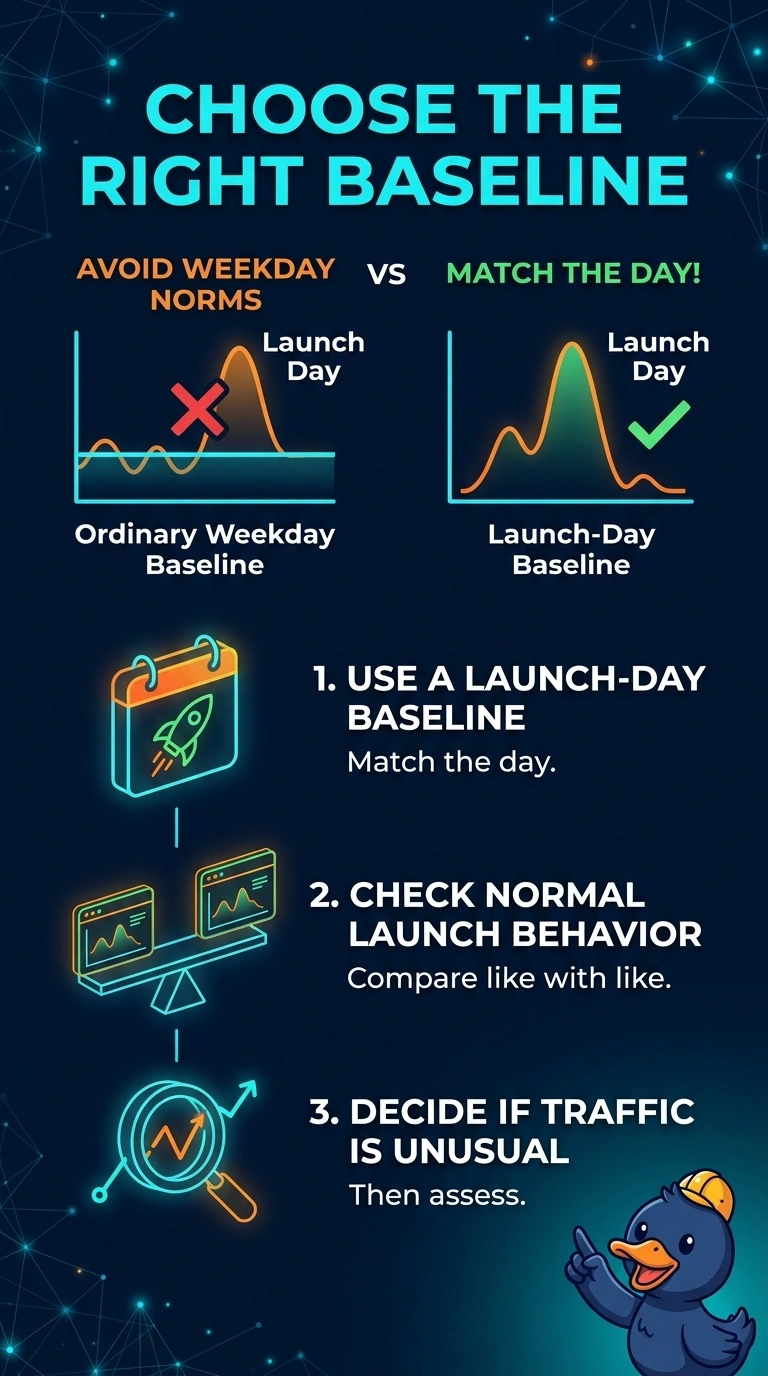
You would not score a festival by how quiet the street is on an ordinary Tuesday. You compare the manufacturer's launch-day traffic with a baseline of normal behavior for that kind of day before you call it an incident. The trap is paging the first sample, raising the threshold until the chart is quiet, or swapping in a ticket count.
Full Explanation
Product-launch day at the manufacturer is a different operating pattern from an ordinary weekday, so weekday traffic is the wrong picture of healthy. Before the launch is called an incident, the team compares it with a baseline of normal behavior for a launch day, built from how prior launches actually looked. Traffic that matches that launch baseline is the event, not an outage; traffic that leaves it is the incident signal. Paging the first sample as soon as it leaves the weekday line treats the existence of the launch as a fault and never asks what a normal launch looks like. Raising the threshold until launch day looks as quiet as a weekday forces the event chart to impersonate a different day, which hides both the launch and any real failure inside it. Substituting a count of tickets opened during the launch measures how many people wrote in, not whether the traffic matches normal launch behavior. Exam caveat: normal behavior is specific to the kind of day, and a weekday baseline will mislabel a planned launch. Operational check: pull the traffic shape from prior launch days, overlay today, and call an incident only where today departs from that launch-day range.