
A hospital campus wants one-way delay measured by sending test packets, not by watching flows that are already on the wire. Which method fits that request?
Select an answer to reveal the explanation.
Short Explanation
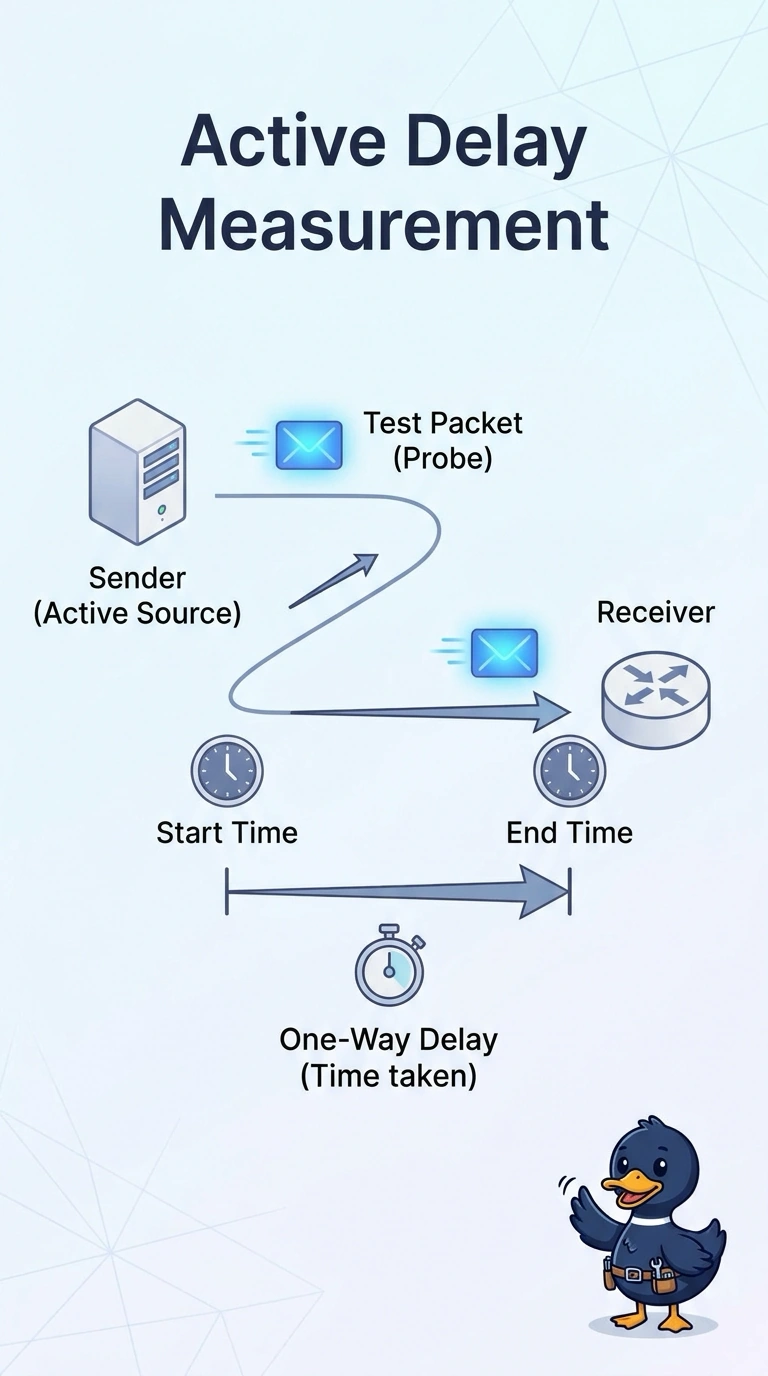
You learn the length of a road by driving it, not by watching other cars from the curb. Your campus asked to send test packets and time them, which is active measurement in the sense RFC 7799 gives that word. Watching existing flows, backing up router configs, or submitting a login form answers a different question than delay from probes you send.
Full Explanation
RFC 7799 calls a method active when the measurement system generates the packets it measures. Timing delay by sending test packets is that method: the probes exist so their departure and arrival can be timed, which is what the campus asked for. Passive observation that only watches flows the campus did not generate is the opposite method; it can describe traffic already present, and it does not send the probes this request requires. A configuration backup of the routers records how devices are set and does not measure delay at all. A synthetic login that submits a form checks an application transaction and does not time a probe across the path, so it does not answer this measurement question. Exam caveat: active and passive are defined by whether the measurement creates the packets, not by which product draws the chart. Operational check: confirm the scheduled test emits the probe packets toward the chosen target and that the delay figure is taken from those probes rather than from unrelated flows.