
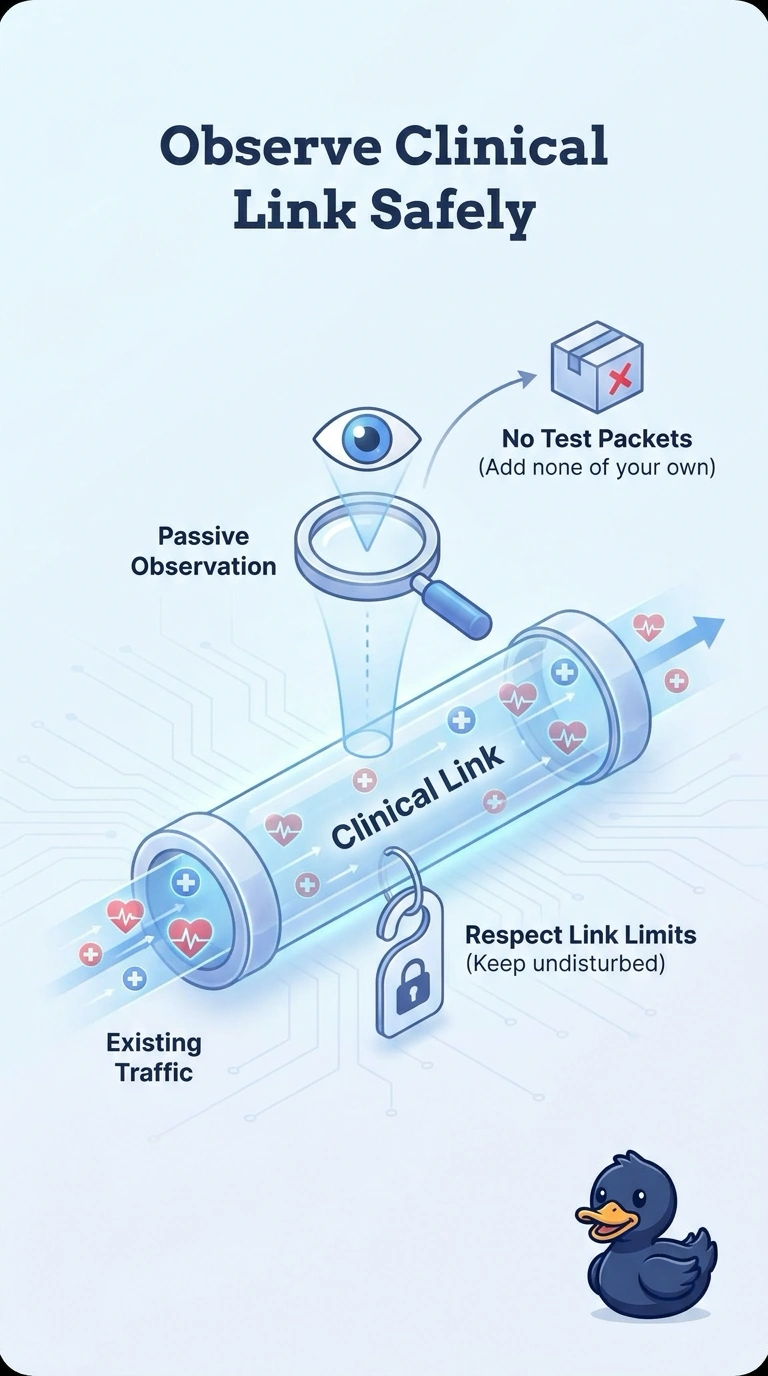
A retailer with branch stores must not inject test traffic onto a saturated in-store clinical link. Which measurement approach respects that limit?
Select an answer to reveal the explanation.
Short Explanation
When a hallway is already packed, you learn who is in it by listening, not by sending another crowd through. You use passive observation of traffic already on that clinical link, because the store must not inject test packets onto a saturated path. Active probes, a config backup, or a synthetic login either add traffic or fail to measure the flow that is there.
Full Explanation
RFC 7799 describes passive measurement as observation of packets the measurement system did not generate. On a saturated clinical link that must not receive test traffic, that is the approach that still sees the traffic already there without adding probes. Active probes that add test packets to the saturated clinical link are the opposite method and violate the limit the store set. A configuration backup that records device settings and does not observe the traffic preserves a copy of configuration and produces no view of loss, delay, or volume on the link. A synthetic login that injects its own transaction instead of honoring the limit is still generated traffic, and it answers an application sign-in question rather than the measurement constraint. Exam caveat: the choice between active and passive here is driven by whether new packets are allowed, not by which chart is easier to read. Operational check: confirm the collector on that link is receiving a copy or observation of existing traffic and that no probe or transaction test is aimed at the saturated clinical path.