
A bank wants a repeatable check that logs into the customer portal and runs a search after each change window. Which agent style fits?
Select an answer to reveal the explanation.
Short Explanation
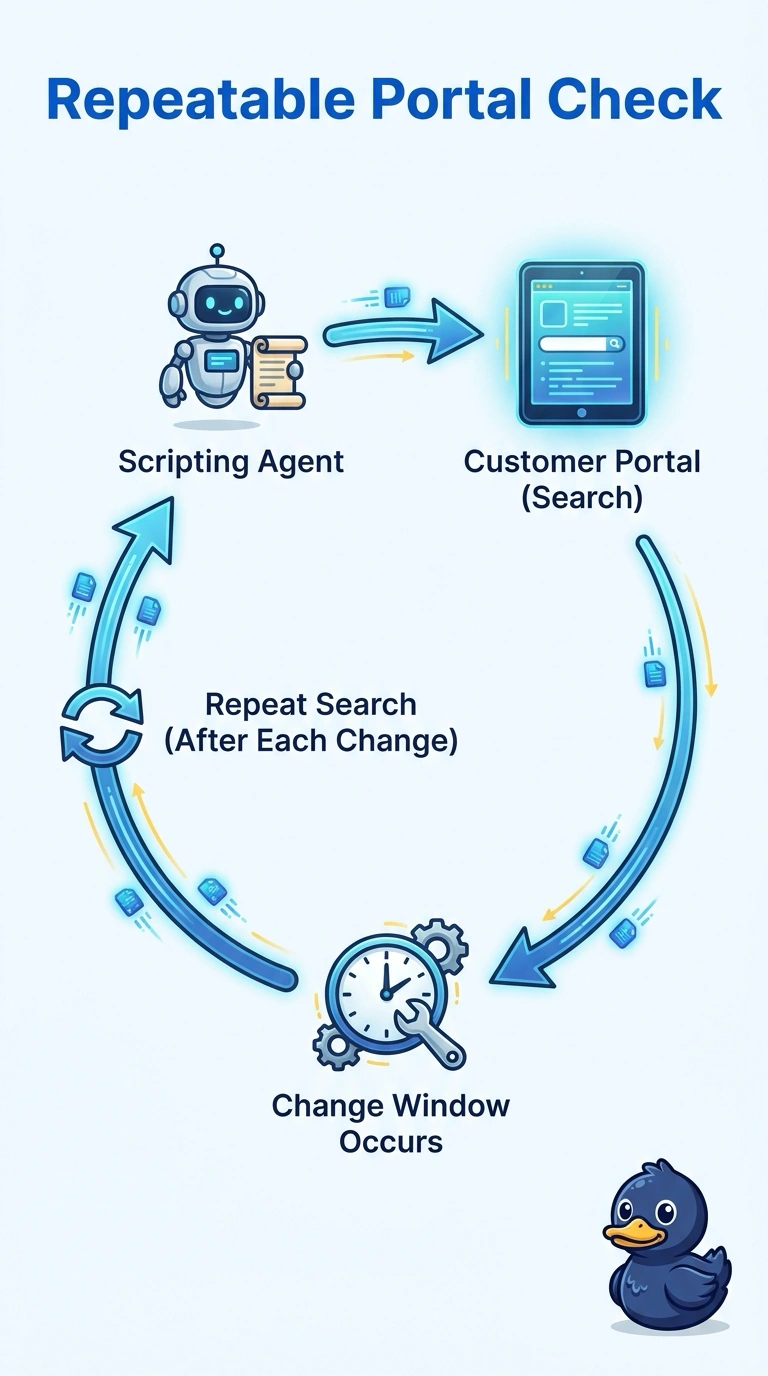
A login followed by a search is a short script you can hand someone, not a glance at the sign out front. You use a scripting agent so that portal transaction runs the same way after every change window. A public page load, a LAN loss collector, or a packet capture that never logs in does not finish the search.
Full Explanation
A login followed by a search is an ordered transaction, and the bank wants that sequence repeated after every change window. A scripting agent that logs in and repeats the portal search after each change performs both steps and fails if either the login or the search does not complete. A synthetic user that only loads the bank public marketing page fetches a public URL. It never authenticates and never runs the search, so a broken search can hide behind a page that still loads. A local collector that samples loss and delay on the branch LAN measures the segment. A clean LAN does not prove the portal login and search still work. A packet capture that records frames but never logs into the portal can show that packets flowed. It does not enter credentials or execute the search, so it cannot tell a completed search from a login that failed. Exam caveat: use a scripting agent when the thing you must prove is an ordered transaction, and use the other styles when the question is a page visit or local loss and delay. Operational check: run the scripted login and search against a known-good portal, confirm the search step succeeds, then break that step in a test system and confirm the agent reports the failure.