
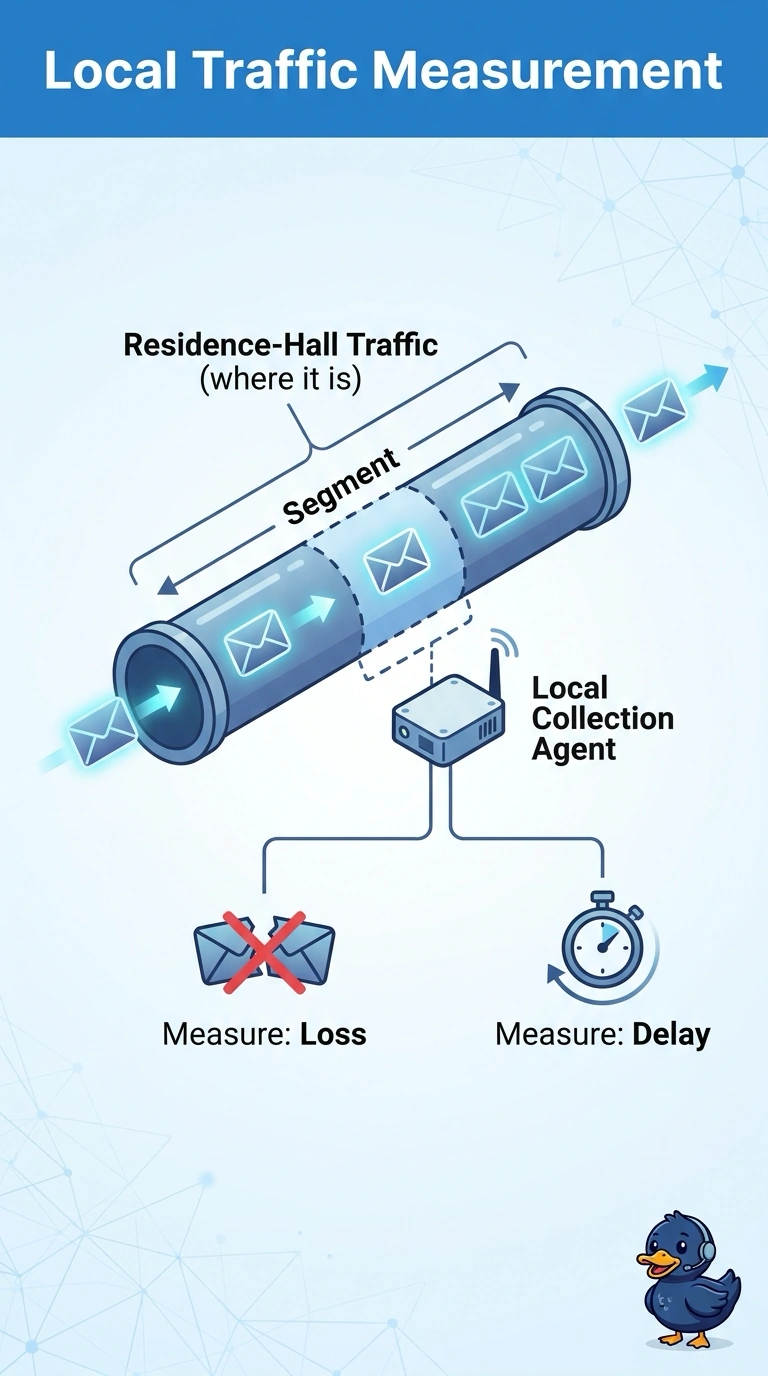
A university wants loss and delay measured on a residence-hall segment, collected where that traffic already is. Which agent style fits?
Select an answer to reveal the explanation.
Short Explanation
Measuring the hallway you are standing in is different from asking someone across town to try a website. You want a local collection agent on the residence-hall segment so loss and delay are taken where that traffic already is. A remote page load, a scripted portal walk, or a capture that never runs that segment test misses the job.
Full Explanation
Loss and delay on a residence-hall segment have to be collected on that segment, because the measurement has to see the traffic where it already is. A local collection agent on the segment where that residence-hall traffic already is sits on the LAN and measures the local loss and delay the university asked for. A synthetic user that opens a public website from outside campus behaves like a remote visitor. It does not sample loss and delay on the hall segment. A scripting agent that logs into a portal and clicks through its pages proves a transaction. That transaction can succeed or fail without reporting loss and delay on the local segment. A packet capture that records frames without running the segment test can store packets for later review. It is not the local collection agent, and it does not produce the ongoing loss and delay measurement this request describes. Exam caveat: the local collector is the agent style for traffic already on the segment, while a synthetic user and a scripted transaction prove application behavior that may be measured from somewhere else. Operational check: confirm the collection agent is attached to the residence-hall segment and that its loss and delay results refer to that segment rather than to a remote page load.