
A retailer with branch stores sees one link flap generate a storm of pages for the same incident. What should the assurance owner do with the alert rule before trusting it in production?
Select an answer to reveal the explanation.
Short Explanation
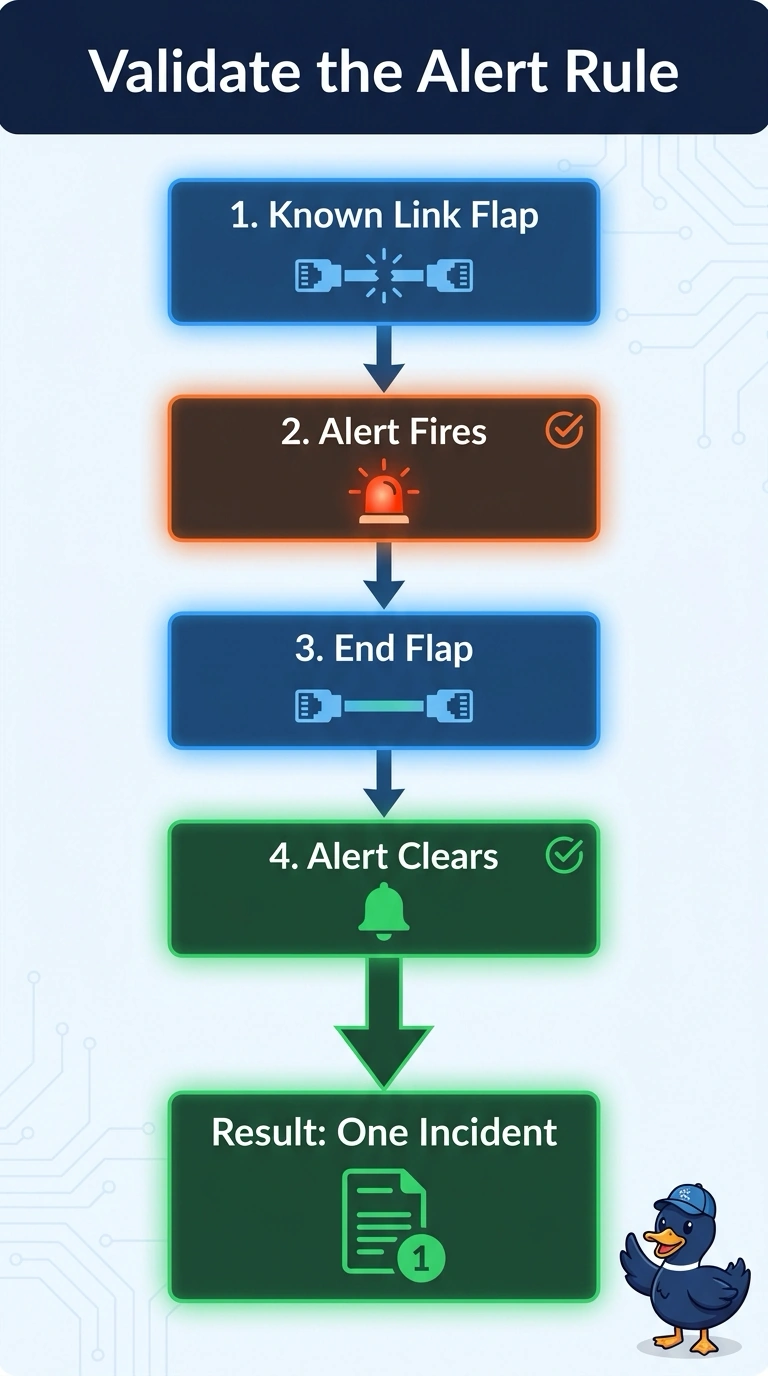
A smoke alarm that never resets will scream all night for one piece of burnt toast. You need to prove this rule fires for a known flap and clears when that flap ends, so one incident does not become a storm of pages. Lowering every threshold, deleting the rule after a single page, or trusting it because it was saved skips that proof.
Full Explanation
A flap storm multiplies pages when the rule raises an alert for each bounce and does not return to a clear state while the underlying incident is still the same link. Proving the rule against a known flap means you drive that condition, confirm one alert fires, restore the link, and confirm the alert clears instead of paging on every transition. That fire-and-clear check is what shows whether one incident stays one incident at the branch stores. Lowering every threshold until the phone goes quiet hides the flap rather than testing whether the rule clears, and it can also hide a later outage the retailer still needs to see. Deleting the rule after the first page removes detection entirely, so the next flap at a store has no rule left to evaluate. Trusting the rule because it was saved, or because the editor accepted the syntax, only shows that the text was stored. Saved text does not demonstrate fire or clear behavior on a live condition. Exam caveat: a rule that pages repeatedly during one flap is a validation failure of the clear path, not proof that more pages are useful. Operational check: flap one known branch link in a maintenance window, count the pages, restore the link, and confirm the alert clears once.