
At a logistics hub, two alert rules page the on-call phone for one path event, so every incident arrives twice. What should the team do to validate those rules?
Select an answer to reveal the explanation.
Short Explanation
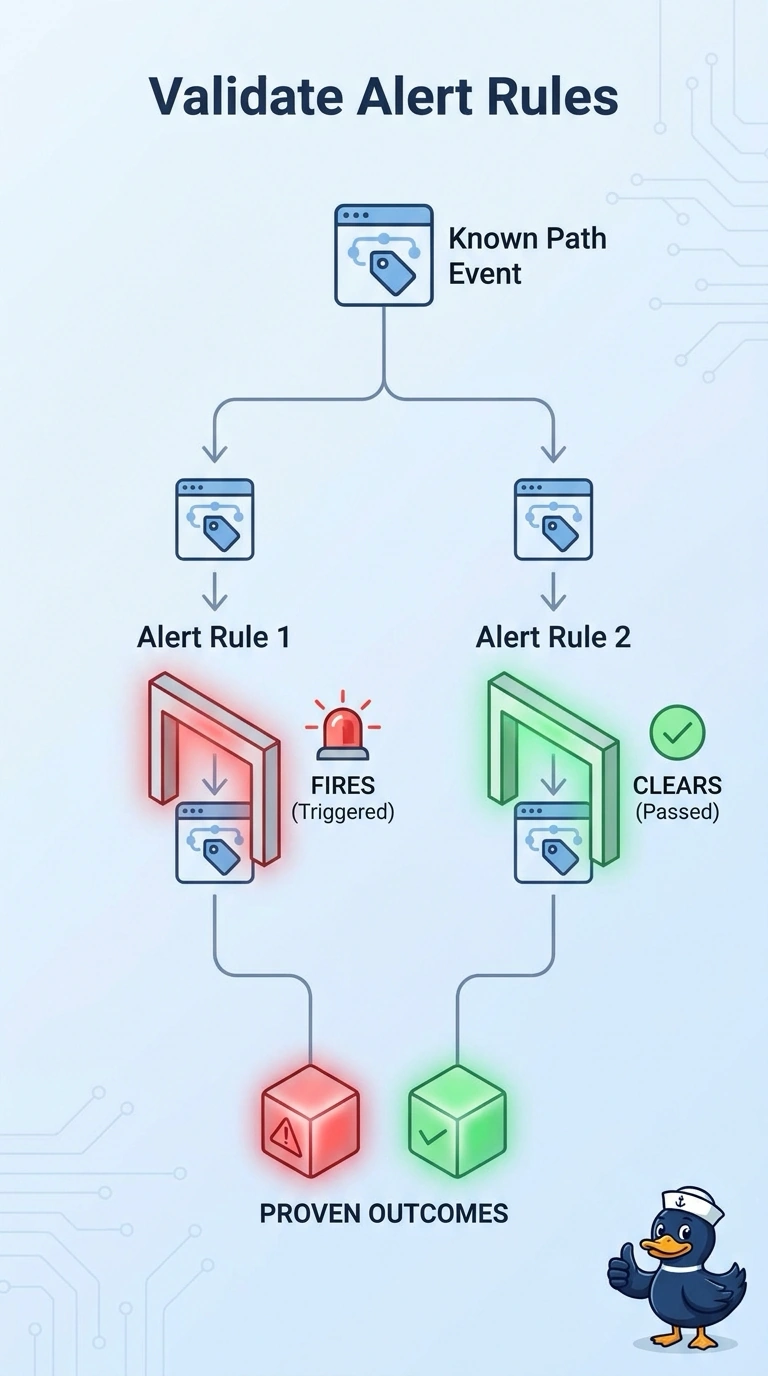
Two smoke alarms on the same pan both yell, and you still have to learn which sensor tripped. You replay one known path event at the logistics hub and prove which rules fire and which then clear. The trap is trusting a saved rule, deleting it after a single page, or lowering every threshold.
Full Explanation
Two pages for one path event mean each rule's match and its clear need to be seen against the same known condition, or the overlap stays a guess. Replaying that condition shows which rules fire, whether they fire together, and whether each returns to a clear state when the condition ends. That is the validation step before anyone rewrites the pair. Lowering every threshold on both rules changes how easily each one trips and does not show whether they are matching the same event or clearing when they should. Deleting one rule after a single double-page throws away a rule whose condition you have not separated from the other, so you still do not know what the remaining rule fires and clears on. Trusting both rules because each was saved only proves the configuration was stored, not that the live match and the clear behave as the hub intends. Exam caveat: a saved rule is not a tested rule, and noise between two rules is settled by a known condition rather than by making every threshold looser. Operational check: trigger one known path event, record which rules page, then remove that condition and confirm each rule clears before you change either definition.