
At a government agency, a dependency alert pages the desk only after the parent alert has already paged for the same event. What should the team do before changing either rule?
Select an answer to reveal the explanation.
Short Explanation
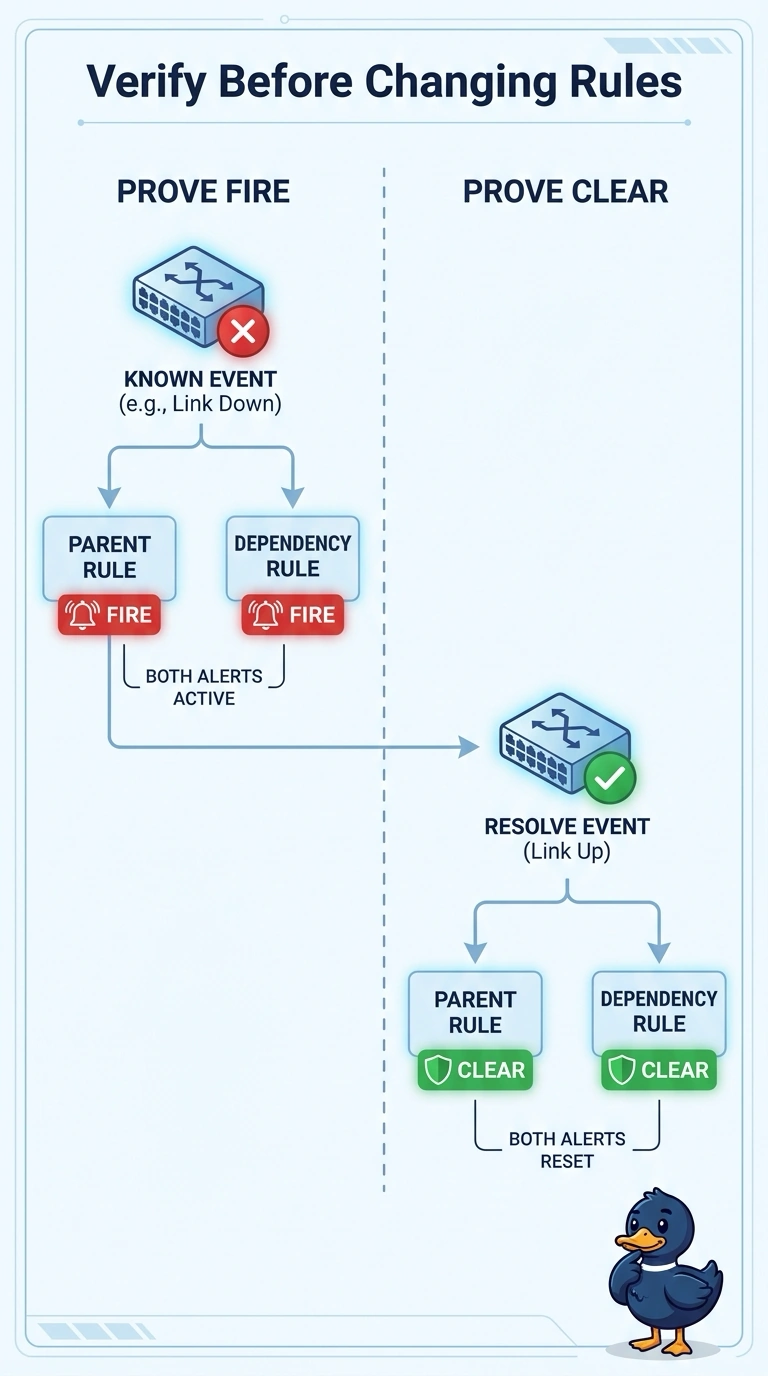
A second bell that rings only after the first bell may be the same event in another hat. You prove how the parent rule and the dependency rule each fire and clear on one known condition. The trap is lowering every threshold, deleting a rule after a single page, or trusting either rule because it was saved.
Full Explanation
The dependency page arrives after the parent page for the same event, so the agency does not yet know whether the second rule is a distinct condition or a late echo of the first. Before either rule is edited, both need to be proved against one known event: when each fires, whether the dependency fires only because the parent did, and when each clears. That replay separates a useful dependency signal from a duplicate page. Lowering every threshold makes both pages less or more eager together and does not show the order or the clear behavior on a known event. Deleting the dependency rule after one extra page removes it before anyone has seen whether it fires and clears on its own condition or only in the parent's shadow. Trusting both rules because they were saved accepts the current double page as designed without evidence of what each match actually is. Exam caveat: dependency alerting still has to be shown to fire and clear on a known condition, and a second page is not self-explanatory just because the rule exists. Operational check: reproduce one known event, log the parent fire time and the dependency fire time, then end the event and confirm each rule clears on its own.