
A university acknowledged one test alert and then deleted the rule, so nothing remains that can fire or clear. Which step should the team take?
Select an answer to reveal the explanation.
Short Explanation
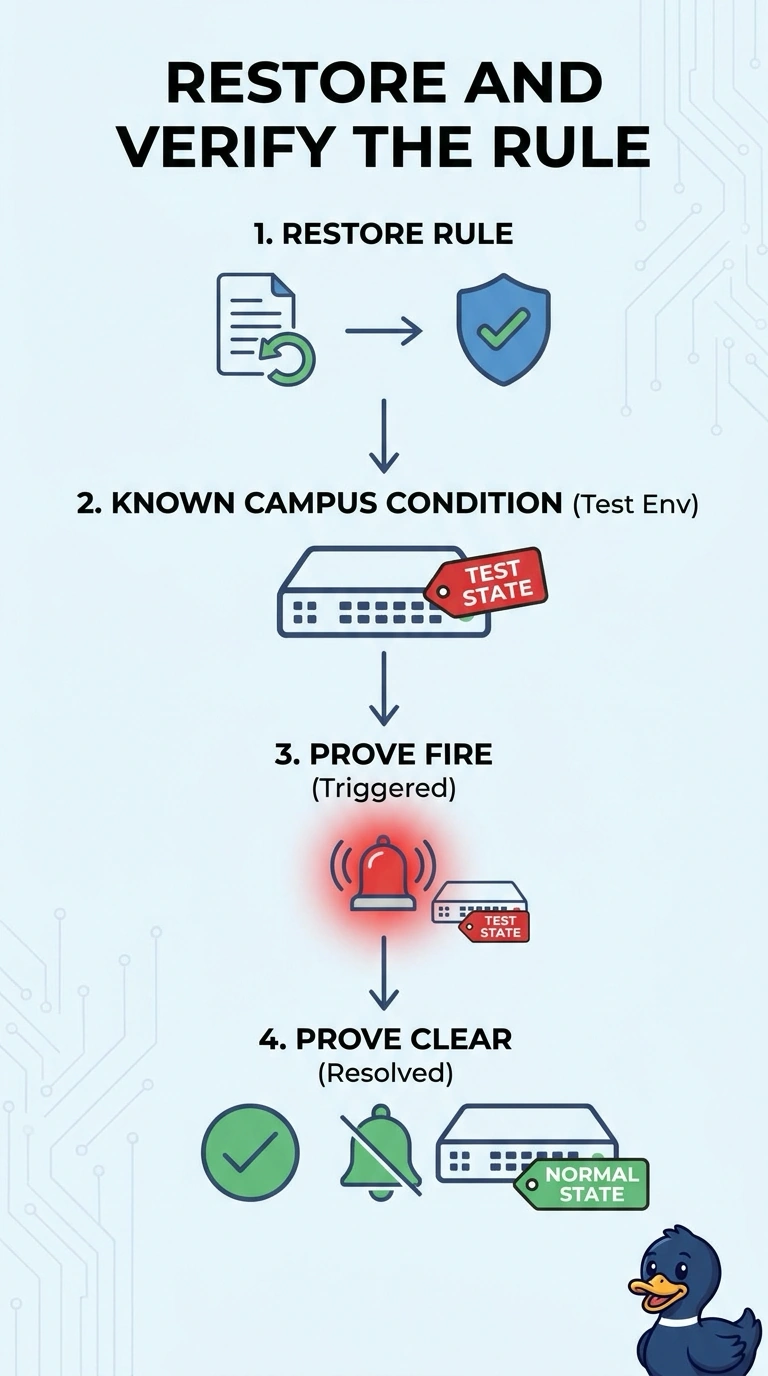
Throwing out the fire-drill checklist after a single drill leaves you with nothing to run next time. You put the rule back and prove it fires and clears against a known campus condition. Lowering every threshold, deleting it again, or trusting the acknowledgement skips that proof.
Full Explanation
Acknowledging a test page records that a person saw it. Deleting the rule afterward leaves nothing that can fire on a real condition or clear when that condition ends. Restoring the rule and proving it fires and clears against a known campus condition is the step that replaces the deleted control and actually tests both transitions. Lowering every threshold until ordinary campus traffic pages without a real fault present creates continuous noise and still does not show a clear state tied to the end of a known condition. Deleting the rule again after the next page so the same drill cannot be repeated repeats the action that removed coverage and makes another validation impossible. Trusting that acknowledging the test page already proved the rule will clear in production confuses acknowledgement with recovery. An acknowledgement does not show that the rule returns to clear when the condition is gone, and the rule is no longer present to do so. Exam caveat: a deleted rule cannot be validated; fire and clear both require the rule to exist and to be exercised on a known condition. Operational check: restore the rule, apply a known campus condition, confirm a page, remove the condition, and confirm the rule clears.