
A retailer with branch stores has an alert that fires during an outage and stays open after the stores have recovered. Which step should the team take?
Select an answer to reveal the explanation.
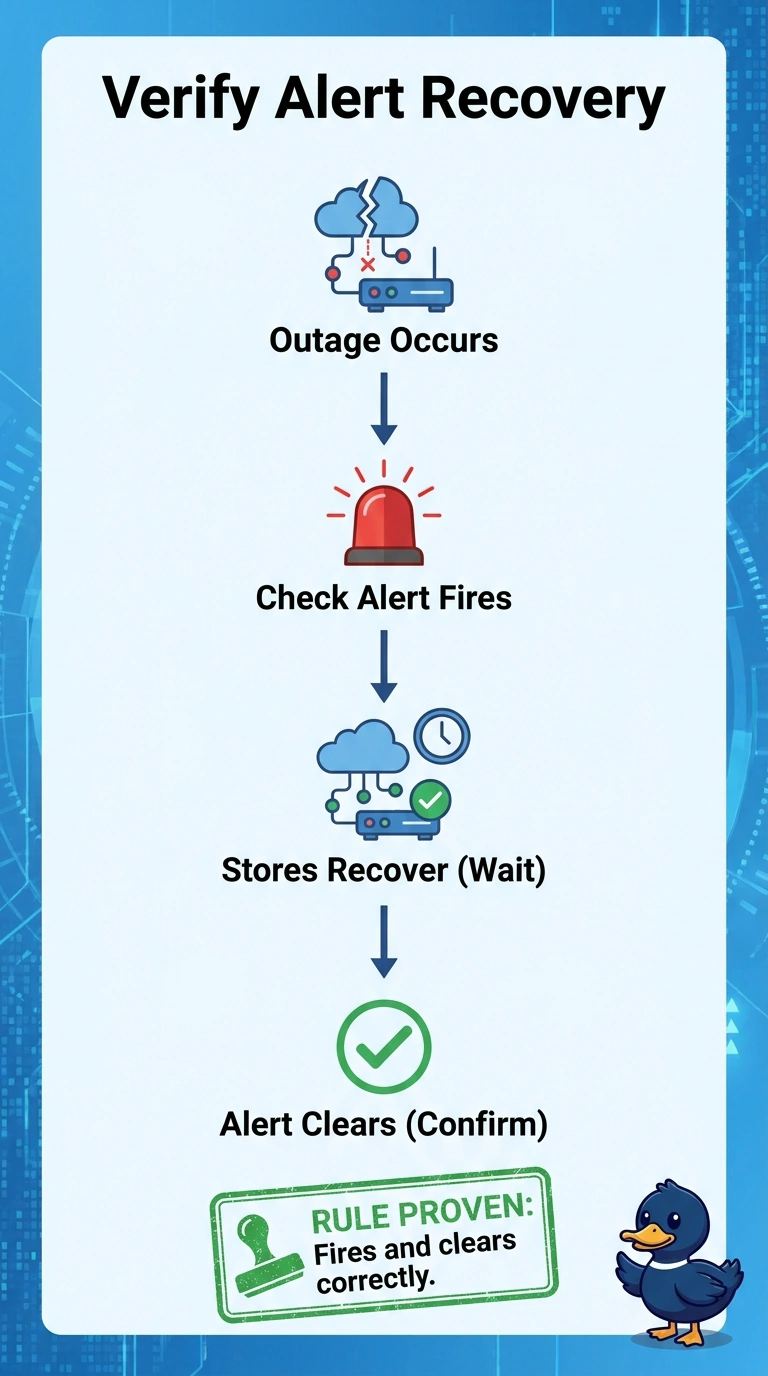
Short Explanation
A fire bell that keeps ringing after the smoke is gone has not finished its test. You prove the rule fires for the outage and clears once the stores recover. Lowering thresholds, deleting the rule after one page, or trusting the save leaves a bell that will not reset.
Full Explanation
An alert that pages during an outage and remains open after the stores recover has demonstrated only half of its behavior. Proving the rule fires for the outage and clears once the stores have recovered is the step that completes validation, because operators need the page when the condition is present and a clear state when the condition is gone. Lowering every threshold so ordinary branch traffic pages along with the stuck alert adds noise and does nothing to make the existing page return to clear after recovery. Deleting the rule after this single page and leaving the branches with no rule in its place stops the stuck page by abandoning detection, so the next outage has no rule to fire or to clear. Trusting the saved rule and assuming it will clear on its own without a recovery test treats the original save as proof of recovery behavior that the stores have already shown is missing. Exam caveat: a rule that fires but does not clear is not a validated rule; both transitions have to be observed against a known condition. Operational check: after a controlled recovery, confirm the same rule that paged during the outage returns to a clear state once the branches are healthy again.