
A hospital campus saved a congestion alert rule and has not exercised it against any known congestion. Which step should the team take next?
Select an answer to reveal the explanation.
Short Explanation
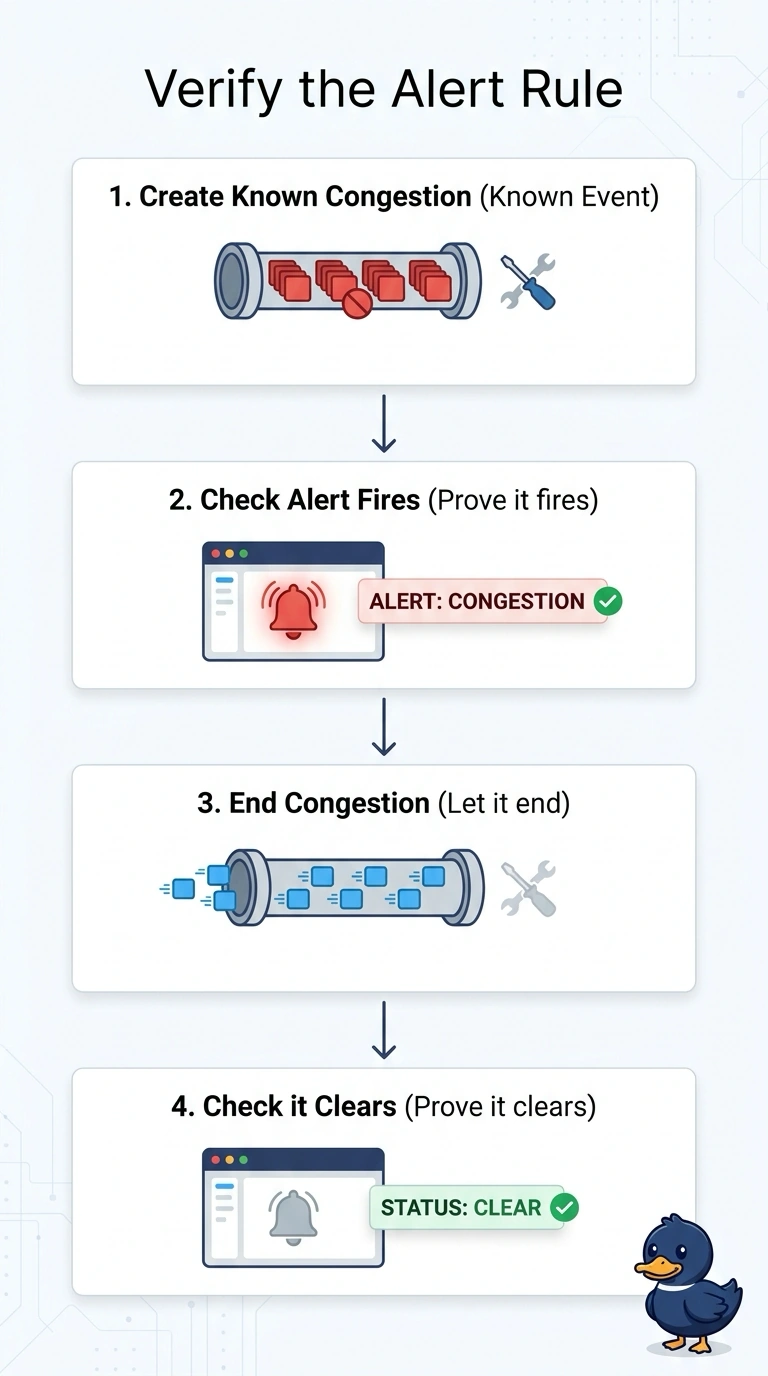
A smoke alarm still in the box has not shown you that it rings or that it resets. You prove the saved rule fires on known congestion and clears when that congestion ends. Lowering every threshold, deleting it after one page, or trusting a save is not that proof.
Full Explanation
Saving a congestion rule stores configuration. It does not demonstrate that the rule will page when congestion is present or return to a clear state when the congestion ends. Proving the rule fires on known congestion and clears when that congestion ends is the required step, because a known condition supplies the contrast a validation needs: page while the condition holds, clear after it is gone. Lowering every threshold until the saved rule pages on ordinary hospital traffic manufactures pages without a known fault, so a page no longer means congestion. Deleting the rule after a single page so the campus cannot receive another page from it removes the control that was supposed to be validated and leaves the campus with no rule for that condition. Trusting the rule on the grounds that saving it proves the rule will fire and will clear treats a successful save as a test. A save confirms the rule was stored, not that detection or recovery behavior works. Exam caveat: an untested rule is not evidence of coverage, even when the save succeeded. Operational check: in a controlled window, introduce known congestion, confirm the rule pages, remove that congestion, and confirm the rule clears.