
A manufacturer expected a maintenance window to suppress a known alert, but the rule still pages while that window is in effect. Which step should the team take?
Select an answer to reveal the explanation.
Short Explanation
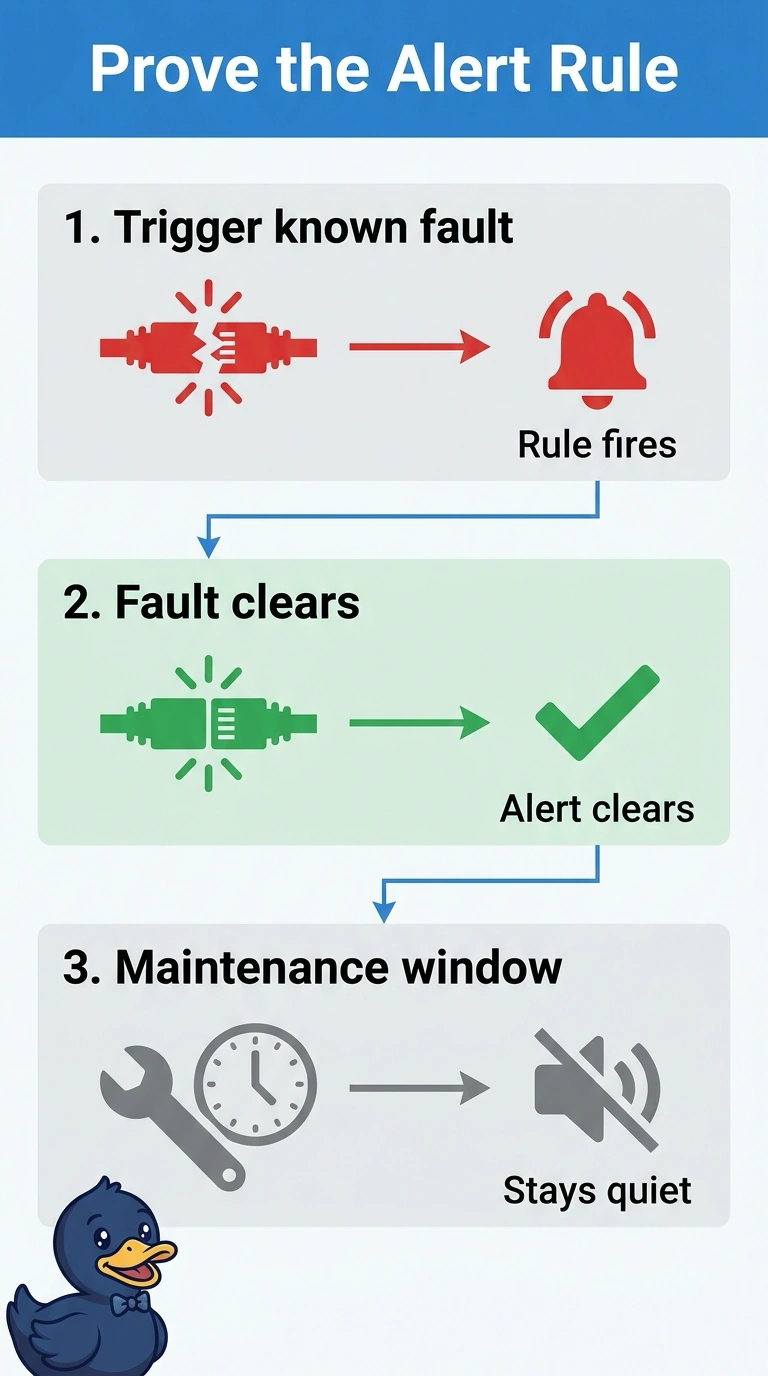
A quiet-hours sign does nothing for you if the alarm ignores the sign. You prove the rule fires on a known fault, clears when the fault ends, and stays quiet inside the maintenance window. Lowering thresholds, deleting the rule after one page, or trusting the calendar entry skips that proof.
Full Explanation
A maintenance window is part of the rule's expected behavior: the rule should page for a known fault outside the window, clear when that fault ends, and stay silent while the window suppresses it. The window is already failing that last part, so the behavior has to be proven rather than assumed. Proving the rule fires on a known fault and clears, including staying quiet in the maintenance window, is the validation step, because each of those outcomes is checked against a condition the team can name. Lowering every threshold so paging during the maintenance window happens even more often increases the pages the window was supposed to suppress. Deleting the rule after this page and leaving the maintenance window with no rule watching that known fault removes detection entirely, including outside the window, where the plant still needs the rule to fire and clear. Trusting the rule because the maintenance window was entered on the change calendar and then saved treats a calendar entry as proof. The pages during the window show that the saved entry is not producing suppression. Exam caveat: suppression is validated the same way fire and clear are validated, by watching the rule against a known condition. Operational check: outside the window, confirm the rule pages for a known fault and clears when the fault ends; inside the window, confirm that same condition does not page.