
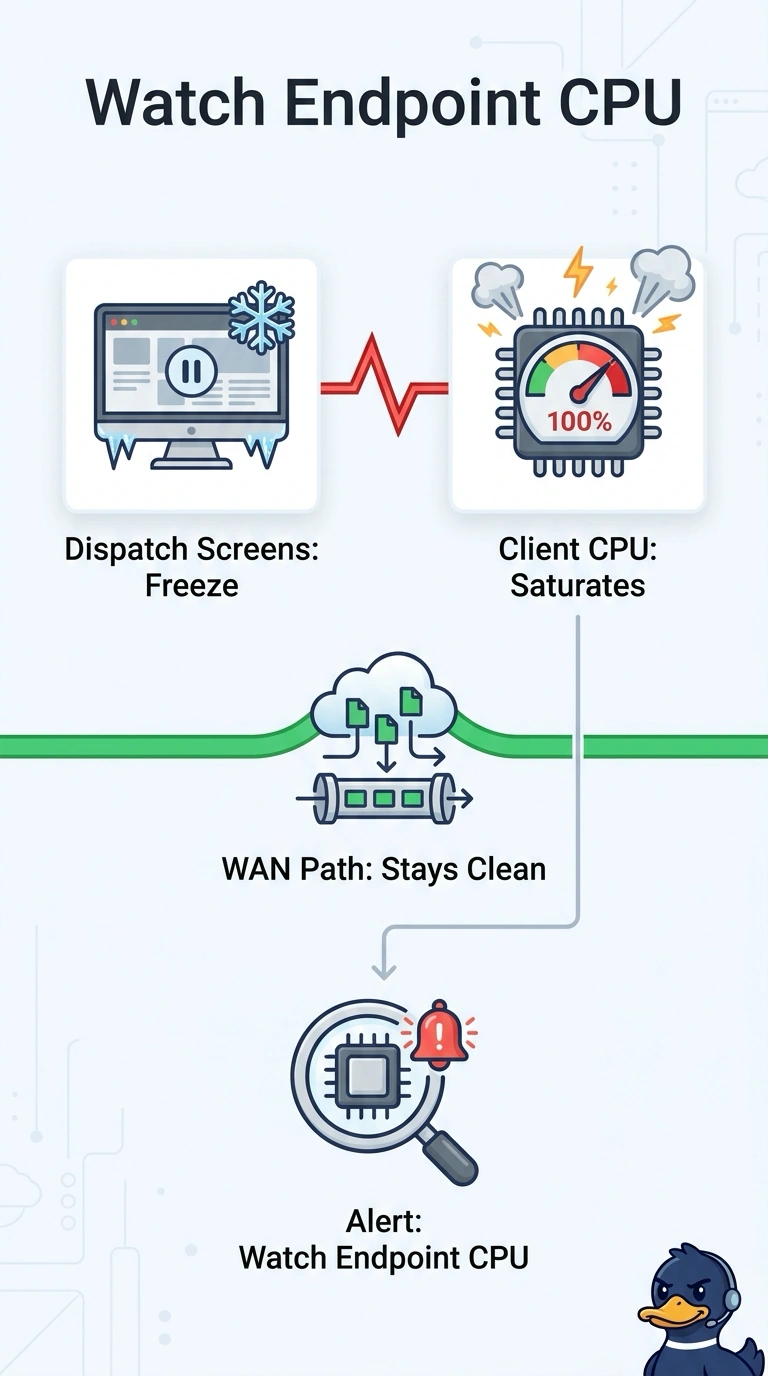
At a logistics hub, dispatch screens freeze only while the client CPU is saturated, and the WAN path stays clean. Which alert should watch that failure?
Select an answer to reveal the explanation.
Short Explanation
A weather report for the highway will not explain a laptop that is too hot to think. You watch endpoint CPU, because that saturation is what lines up with the freeze and the WAN path stays clean. BGP state, a core interface alarm, or a weekly note that skips the client is aimed at the wrong machine.
Full Explanation
The freeze tracks client CPU saturation, and the WAN path stays clean, so the alert belongs on the endpoint CPU. That signal is the end-user condition the evidence names, and it can page when the device itself is the cause. A BGP-state alert on edge routers the freeze does not involve watches session state those screens are not failing on, so a routing change is the wrong page for a local CPU stall. An SNMP interface alarm on a core router while the WAN path stays clean watches a box the path evidence has already cleared, and an interface counter there does not read the client processor. A weekly executive note that never watches CPU on the client arrives late and never sees the signal that matches the freeze. Exam caveat: an end-user alert is justified when the client metric explains the symptom and the path metric does not. Operational check: plot client CPU against freeze timestamps and confirm the rule is bound to that CPU signal rather than to edge BGP or core interface state at the hub.