
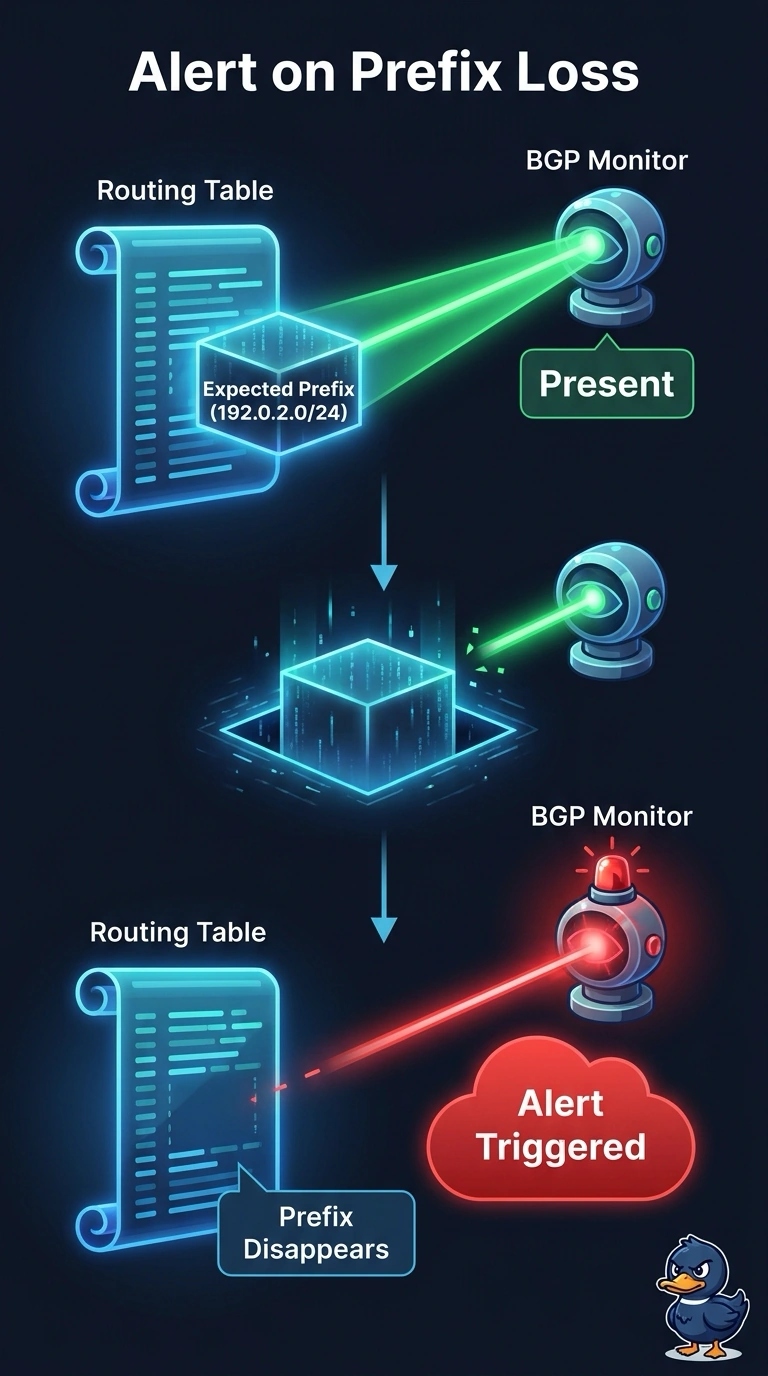
A retailer's edge router loses the expected prefix from its BGP table, and the branches that depend on that prefix go dark. The NOC wants a page when the prefix disappears. Which alert fits?
Select an answer to reveal the explanation.
Short Explanation
When the highway sign for your exit disappears, you alarm on the missing sign. You alert on routing-table state when the expected prefix disappears, because that is what made the branches go dark. A register CPU alert, a map with no rule, or a later capacity study does not page you for that prefix.
Full Explanation
The edge router's BGP table has lost the expected prefix, and the branches that depend on it go dark, so the page belongs on routing-table state when that prefix disappears. The network condition is the missing route, and an alert on that state tells the NOC when the same disappearance happens again. An end-user CPU alert on registers in those branches watches point-of-sale devices. Register load does not read the BGP table, so it cannot tell a missing prefix from a busy register, and it is the wrong layer for a routing event. A routing dashboard that draws the BGP table can show the gap, but with no alert rule on it the drawing never pages the NOC when the prefix drops out. A capacity project that studies the missing prefix later may ask whether a circuit should change, yet it does not page the NOC at all, so the branches can go dark again with no operational page. On the exam, a BGP or routing-table failure is an alert on that routing state, not a picture of the table and not a capacity plan. In production, withdraw a test prefix or use a known missing-prefix case and confirm the routing-state alert pages, then confirm it clears after the expected prefix returns to the table.