
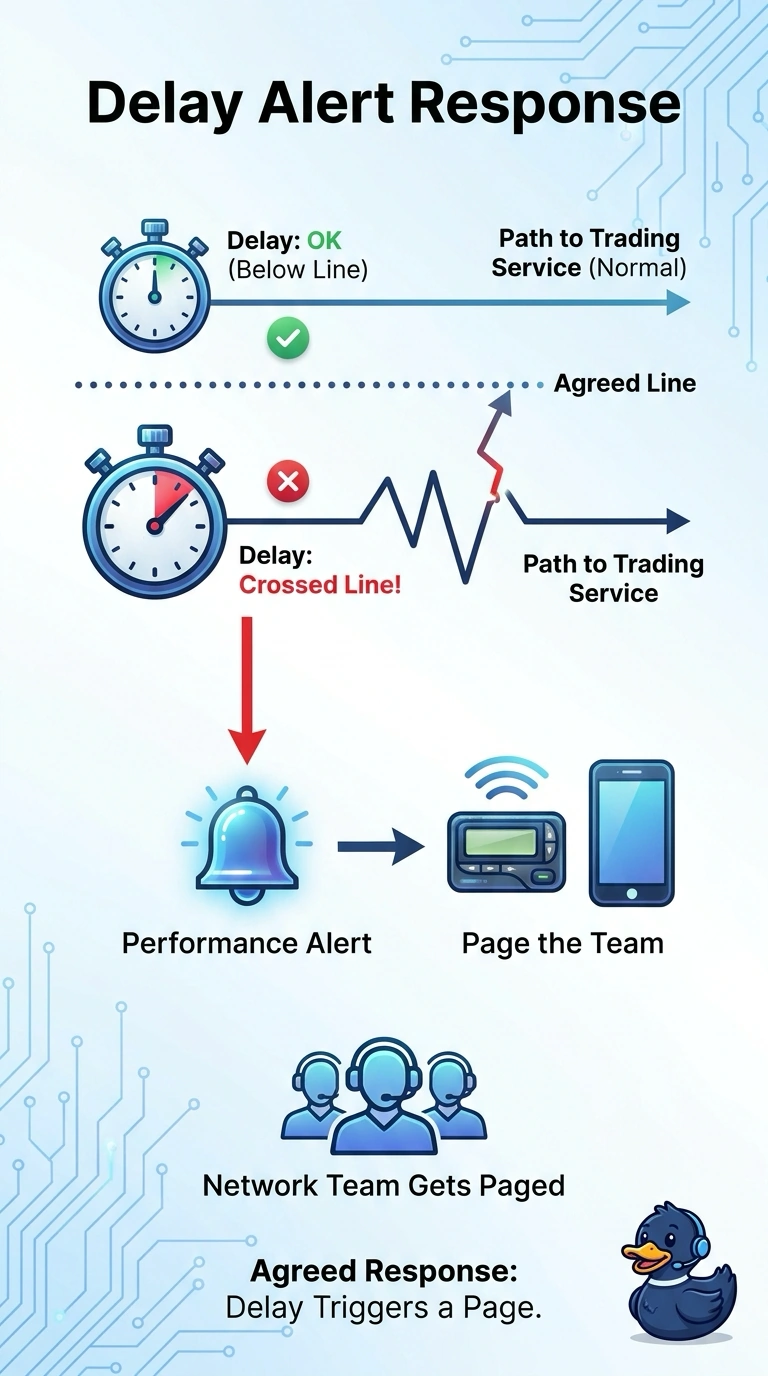
A bank agreed that delay on the path to the trading service would page the network team once it crossed a line they had set, and that delay has now crossed the line. Which response fits the agreement?
Select an answer to reveal the explanation.
Short Explanation
A speed sign you already posted isn't the same thing as a blueprint for a new road. You raise a performance alert when path delay crosses the line the bank agreed would page the team. A laptop CPU alert, a chart with no rule, and a capacity project don't meet that agreement.
Full Explanation
The bank already agreed that path delay past a line they set would page the network team, and that delay has crossed the line, so the matching response is a performance alert that pages. The alert is how the agreement becomes a notification rather than a number someone might notice later. An endpoint CPU alert watches a trader laptop processor, which is a different symptom from delay on the path. A dashboard of delay charts can show the breach and still page nobody when no rule is attached to the view. A capacity project may redesign the trading floor later and does not page anyone for the delay that has already crossed the agreed line. Watching, redesigning, and checking a laptop processor each leave the agreed page undone. Exam caveat: once a performance condition was accepted as a paging condition, the matching action is the alert that sends that page. Operational check: confirm the performance rule notifies the network team for path delay and that the dashboard alone has no notification destination.