
A hotel chain's synthetic web test ends on the loyalty login page, yet leaders say guest checkout is being monitored. What limits that claim?
Select an answer to reveal the explanation.
Short Explanation
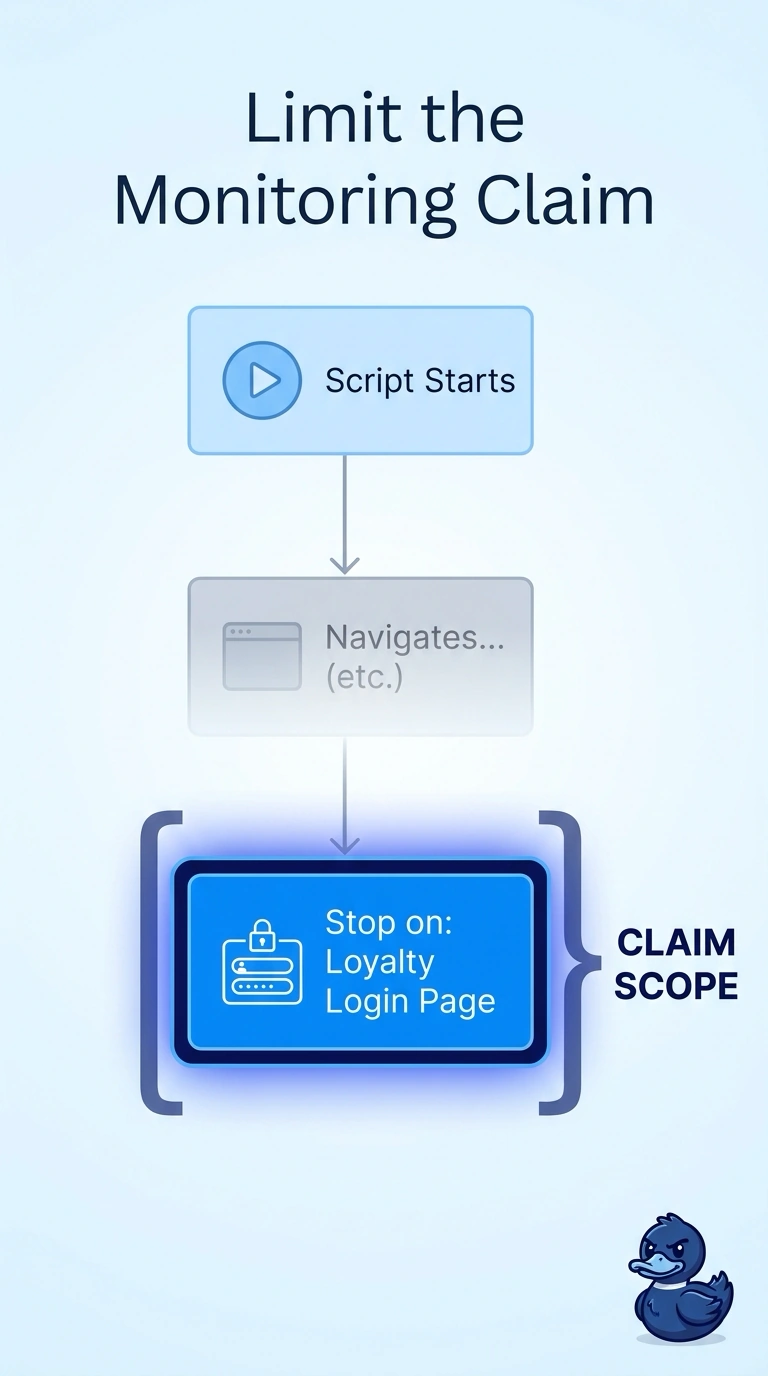
A tour that ends at the lobby door has not shown you the rooms upstairs. You can claim only what the script's last step reached, so a login page does not monitor checkout. A green login is not a census of every guest, a capture of the reservation database, or a stand-in for a real client's waterfall.
Full Explanation
A synthetic web test covers the steps the script actually performs and stops where the script stops. This hotel test's last step is the loyalty login page, so the monitored transaction is login, not guest checkout. Leaders who describe checkout as monitored are extending the claim past the script. Treating the green login as proof that every real guest completed checkout invents both a step the script never ran and a census of browsers the agent does not represent. Treating the login test as a packet capture of the reservation database confuses a scripted page transaction with a copy of database queries, which this test does not record. Replacing a real guest's browser waterfall with the synthetic script drops the object timing a real client would show, and it still would not create a checkout step the agent never executed. The green result remains valid for the login path from the agent's location. It is not evidence about pages after the script ends. Exam caveat: the last scripted step is the boundary of a synthetic web claim. Operational check: read the transaction steps and confirm there is no checkout action after the login page.