
A government agency runs synthetic web tests from a single city and treats each green result as proof for users in every country. What is the honest limit of that result?
Select an answer to reveal the explanation.
Short Explanation
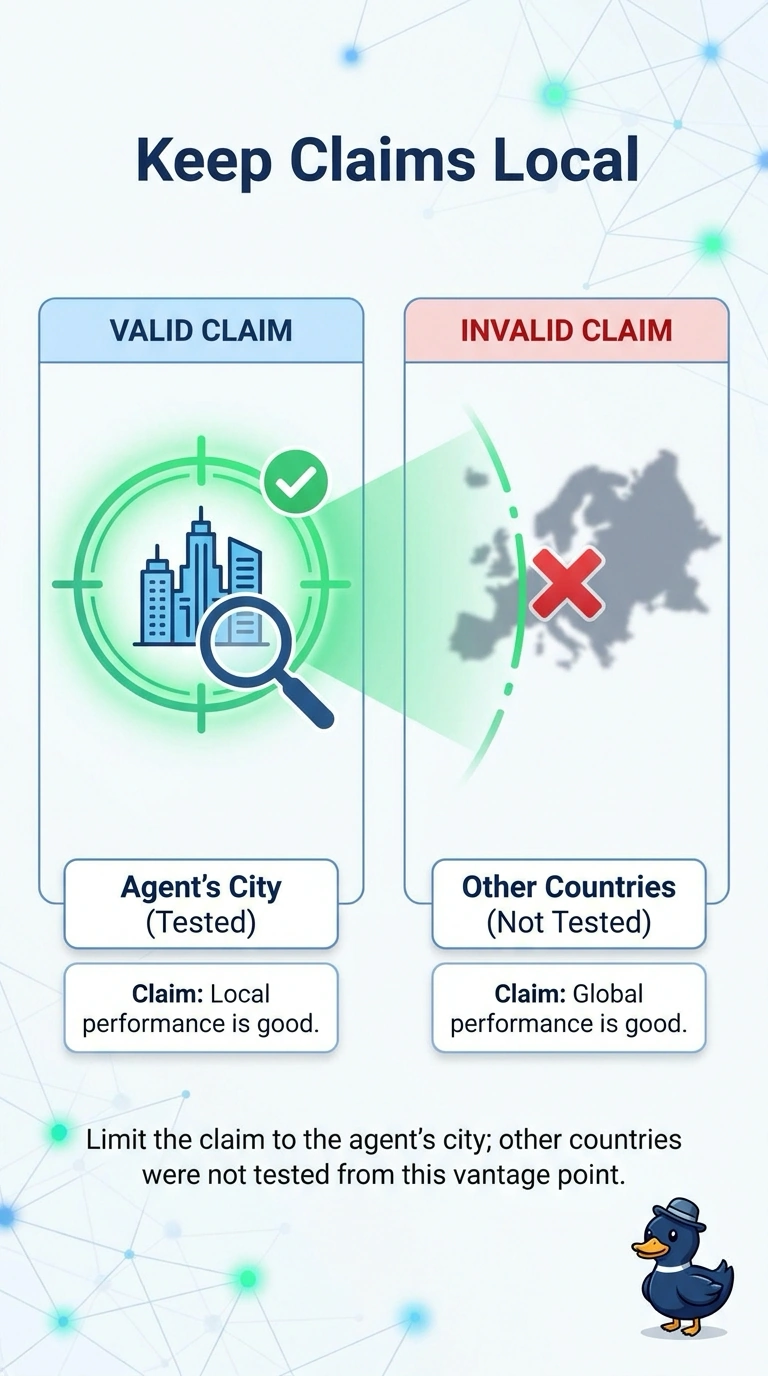
A weather report from one city does not tell you it is sunny in every country. You limit the claim to the city where the synthetic agent actually ran. That vantage point is not proof for every real user abroad, a packet capture of the database, or a replacement for waterfalls on real clients in other countries.
Full Explanation
A synthetic web test measures the path and the transaction from the agent that ran it. This agency's agent sits in one city, so a green result speaks for that city and for the network path leaving it. Countries where no agent ran are outside the claim, even when the application is the same. Treating the green test as proof that every real user's browser succeeded in every country the agency serves ignores both geography and the difference between a script and a population of clients. Treating the synthetic test as a packet capture of the application database confuses a scripted transaction with a copy of server-side queries, which the agent does not collect. Replacing browser waterfalls from real clients abroad with this script drops client-side timing those users actually experienced, and it still leaves their countries untested. Publish the result with the agent location attached. Do not brief it as worldwide coverage. Exam caveat: vantage point is part of the result, and one city does not sample every country. Operational check: list the agent location on the report and withhold any country where no synthetic agent or real-client evidence exists.