
At a logistics hub, a scripted ThousandEyes web test stays green while one browser build throws a JavaScript error on the tracking page. What can the assurance team honestly claim about that error?
Select an answer to reveal the explanation.
Short Explanation
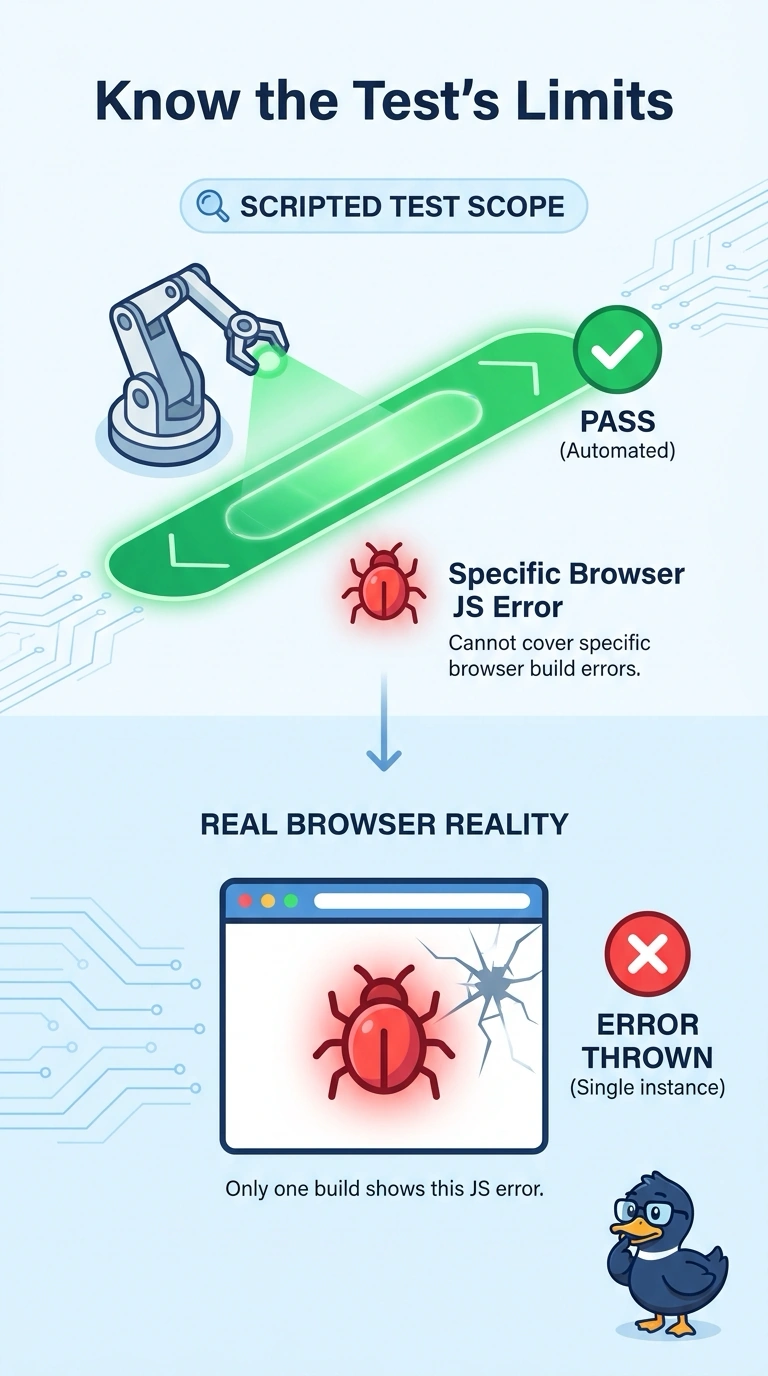
A scripted robot can walk a marked trail and still miss the loose board that only one kind of shoe hits. You cannot treat a green synthetic web test as coverage for a JavaScript error that shows up in only one real browser. The trap is reading that green run as a census of every user, a database capture, or a substitute for a real client's waterfall.
Full Explanation
A scripted synthetic web test reports the transaction and the browser that the agent actually executed at the logistics hub. A JavaScript error that appears only in a different browser build does not run inside that script, so a green result is not coverage for the bug. Treating the green run as proof that every real browser at the hub executed the page cleanly turns one scripted vantage point into a census of user agents the test never launched. Treating the synthetic web test as a packet capture of the tracking database confuses an application transaction with a record of queries inside the data tier, which this test does not collect. Replacing the real client's browser waterfall with the script discards object-level timing that only that client's browser recorded. The script can still be useful for the path and the steps it actually completed. It simply cannot stand in for a browser-specific failure it did not execute. Exam caveat: synthetic web coverage is bounded by the script, the agent location, and the browser the agent used. Operational check: compare the browser build that threw the error with the browser the scripted agent runs, and keep a real-client waterfall for the build that failed.