
A university wants a synthetic web test of the course portal to prove which database query plan the portal used for a slow search. Which statement describes the limit of that web test?
Select an answer to reveal the explanation.
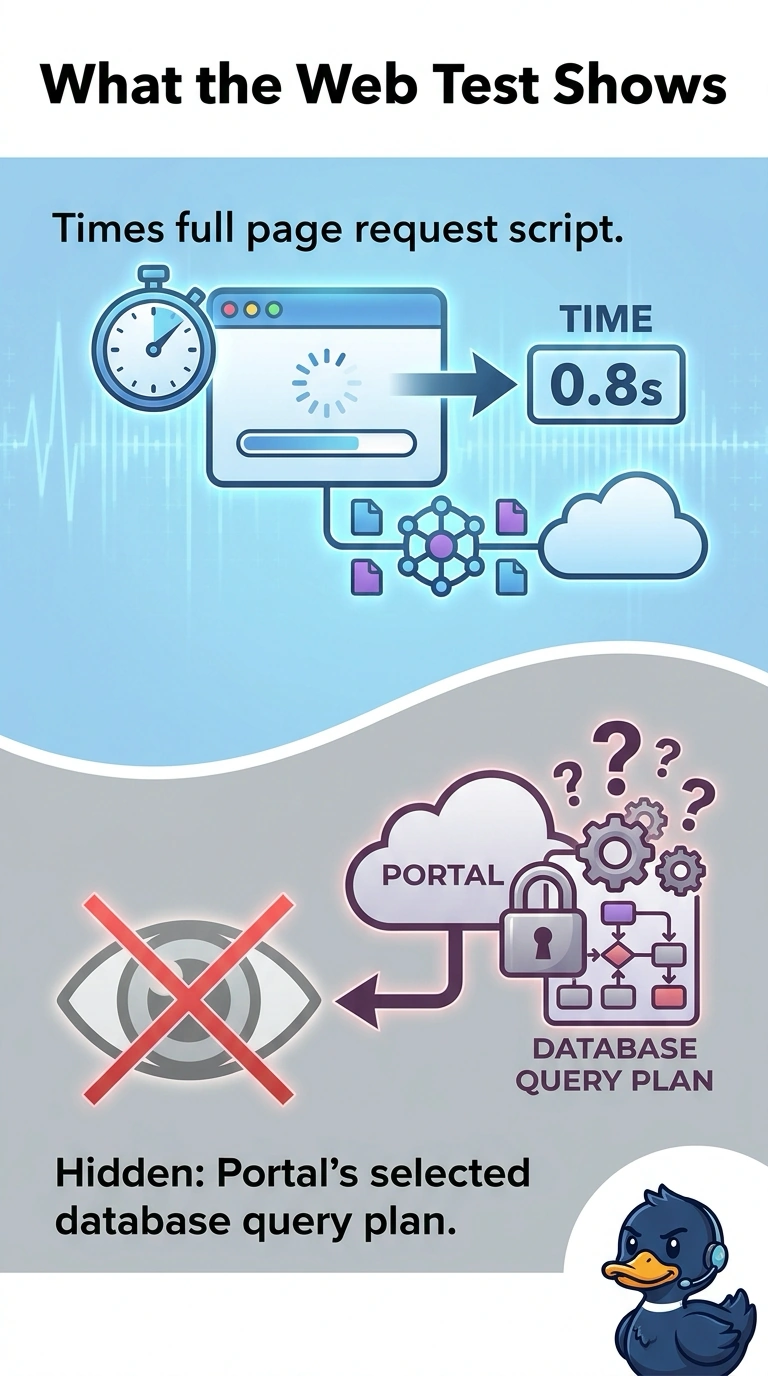
Short Explanation
A stopwatch on the storefront does not tell you how the stockroom chose which box to fetch. You accept that a synthetic web test cannot show the database query plan the university hoped to prove. The trap is treating that test as proof for every real user, as a packet capture of the database, or as a replacement for a real-client waterfall.
Full Explanation
A synthetic web test requests the course-portal page the script names and records how that page loads in the scripted browser. The database query plan is the optimizer's choice inside the database engine, and nothing in the web transaction exposes which plan was selected. The limit is that the test times the page and does not reveal the plan, no matter how green or how slow the search looks from the browser. Claiming the test proves the search for every real student overstates a single scripted client and still would not turn that client into a query plan. Claiming the test is a packet capture of the portal database confuses a web transaction with a capture on the database path, and even database packets are not the plan the optimizer chose. Claiming the test replaces a browser waterfall on a real student swaps one browser view for another; a real-client waterfall shows that student's objects and waits, and it still does not print the query plan. Exam caveat: web timing and a query plan are different evidence, and a synthetic test supplies the first only. Operational check: if the question is the plan, collect it from the database engine that ran the search, and keep the synthetic result as the page-timing evidence it actually is.