
A retailer with branch stores wants to close page-failure tickets because a synthetic test is green, but that scripted test does not run the browser extension installed on the store laptops. What should the team recognize before closing a ticket?
Select an answer to reveal the explanation.
Short Explanation
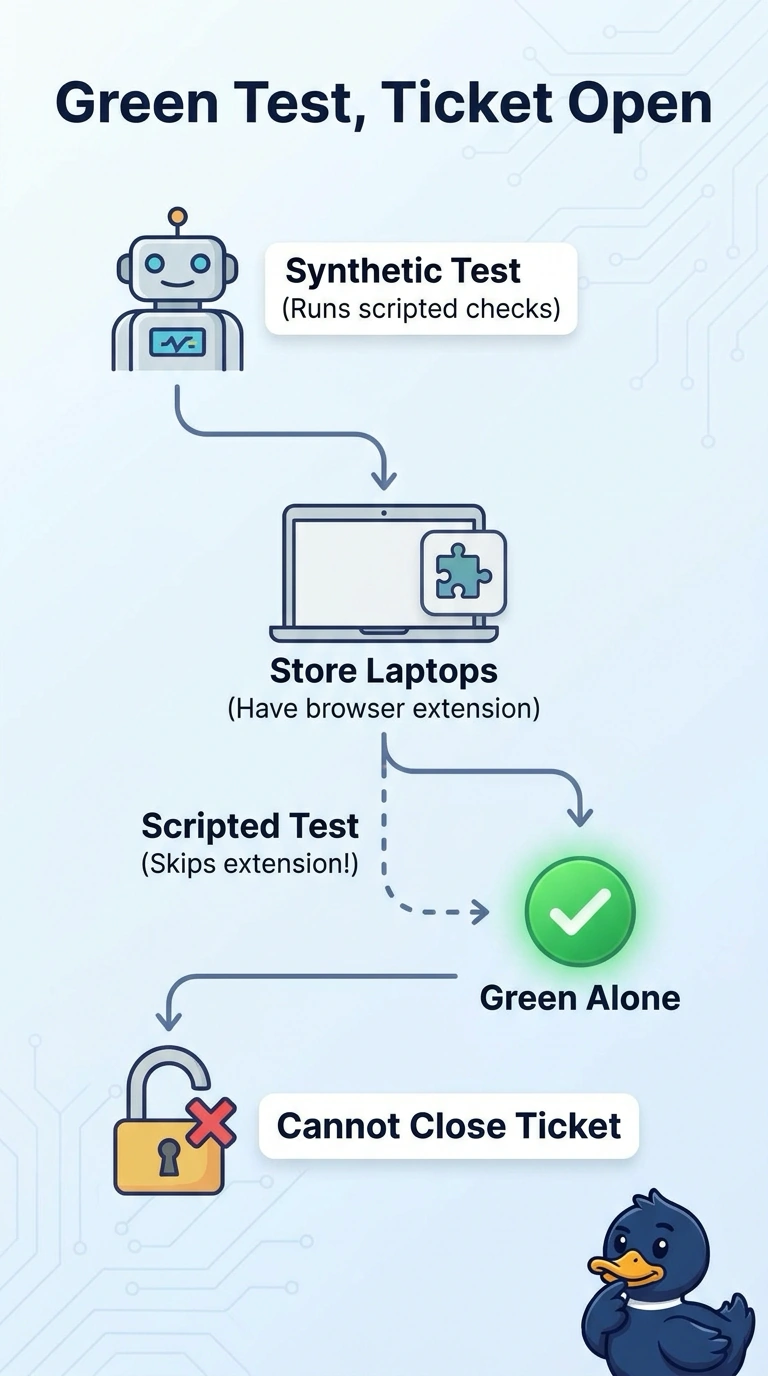
A fitting room that does not hand you the glasses shoppers actually wear cannot clear the complaint. You refuse to close the retail ticket until you account for the browser extension the synthetic test does not run. The trap is treating that test as proof for every real user, as a database capture, or as a substitute for a real-client waterfall.
Full Explanation
The store laptops load a browser extension, and the scripted synthetic test does not run that extension, so its green result never exercises the client the cashiers use. The team has to recognize that limit before closing the ticket, because the complaint may live entirely inside the extension the script omits. Calling the green test proof for every real user, including staff whose laptops load the extension, ignores the client piece the test left out. Calling the synthetic test a packet capture of the store database misstates it: a web transaction is not a capture of database traffic, and a capture would not by itself show the extension either. Calling the synthetic test a replacement for a browser waterfall on a real store laptop skips the view that would include the extension; the scripted run cannot stand in for that client. Exam caveat: a synthetic web test covers the browser and the steps the script actually loads, and an extension that is absent from the script is outside the green result. Operational check: list what the scripted browser loads, confirm the store extension is absent, and keep the ticket open until a real laptop that has the extension is measured.