
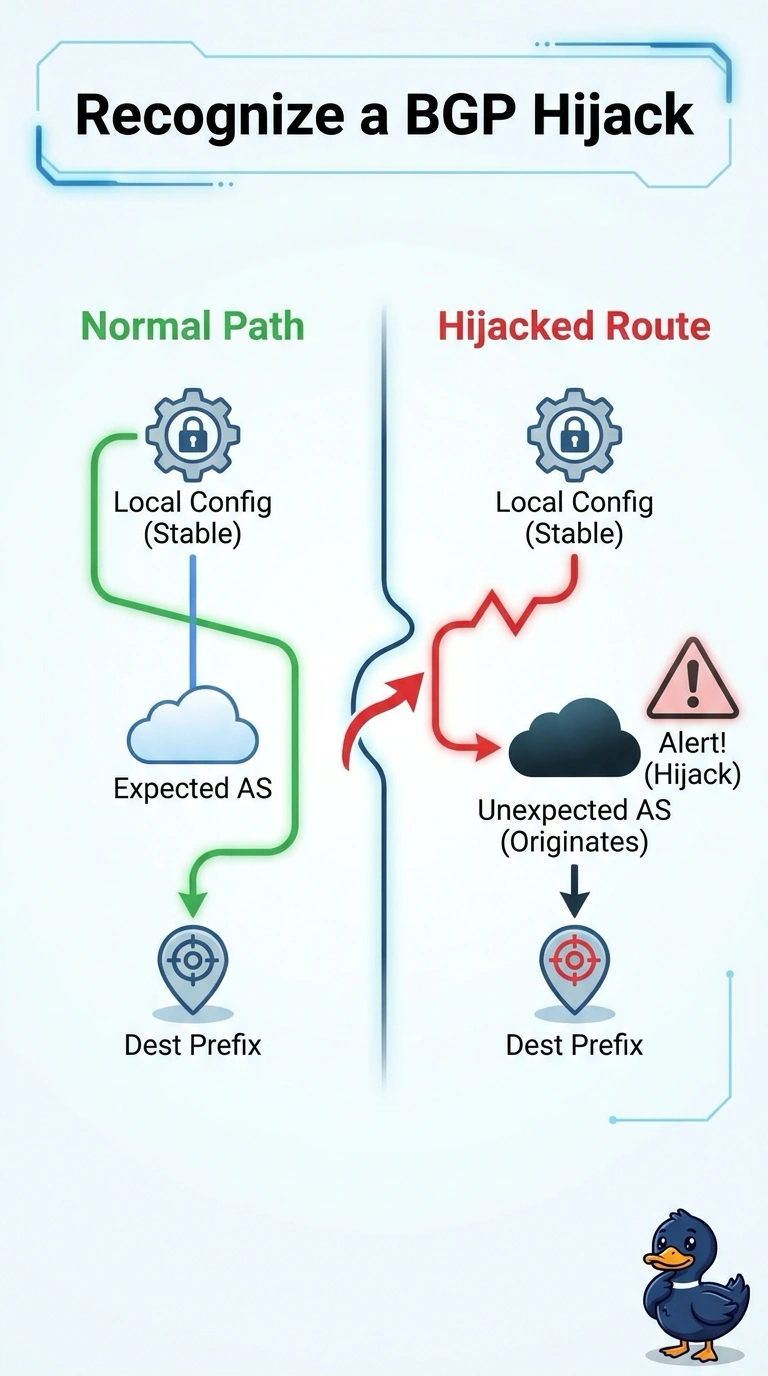
A government agency sees one of its prefixes originated by an unexpected autonomous system, and the local router configuration did not change. What should the team call this event?
Select an answer to reveal the explanation.
Short Explanation
If a stranger starts receiving your mail because they claimed your house number, you do not remodel the kitchen. An unexpected autonomous system is originating the agency prefix and the local configuration did not change, which is a BGP hijack. The trap is treating that shift as a bandwidth gap, a QoS issue, or a bad laptop.
Full Explanation
Origin of a prefix by an autonomous system that the agency does not expect, with no change to the local router configuration, is the definition of a BGP hijack in operational terms: someone else is announcing the prefix. The response is to treat the event as that hijack and to work the route, the upstream filters, and the unauthorized origin. A need for more bandwidth on the agency uplink would show up as a full local circuit, not as a new origin for the prefix. A QoS problem that retuning the edge policy would clear is about marking and queues on traffic the agency still forwards, and it does not explain an unexpected origin. A faulty user laptop that should be replaced at the site cannot originate the agency prefix in BGP. Exam caveat: do not relabel an origin change as capacity or quality of service merely because users feel slowness while the route is wrong. Operational check: compare the observed originating autonomous system with the origin the agency intends to announce, and confirm the local configuration timestamp did not move when the origin changed.