
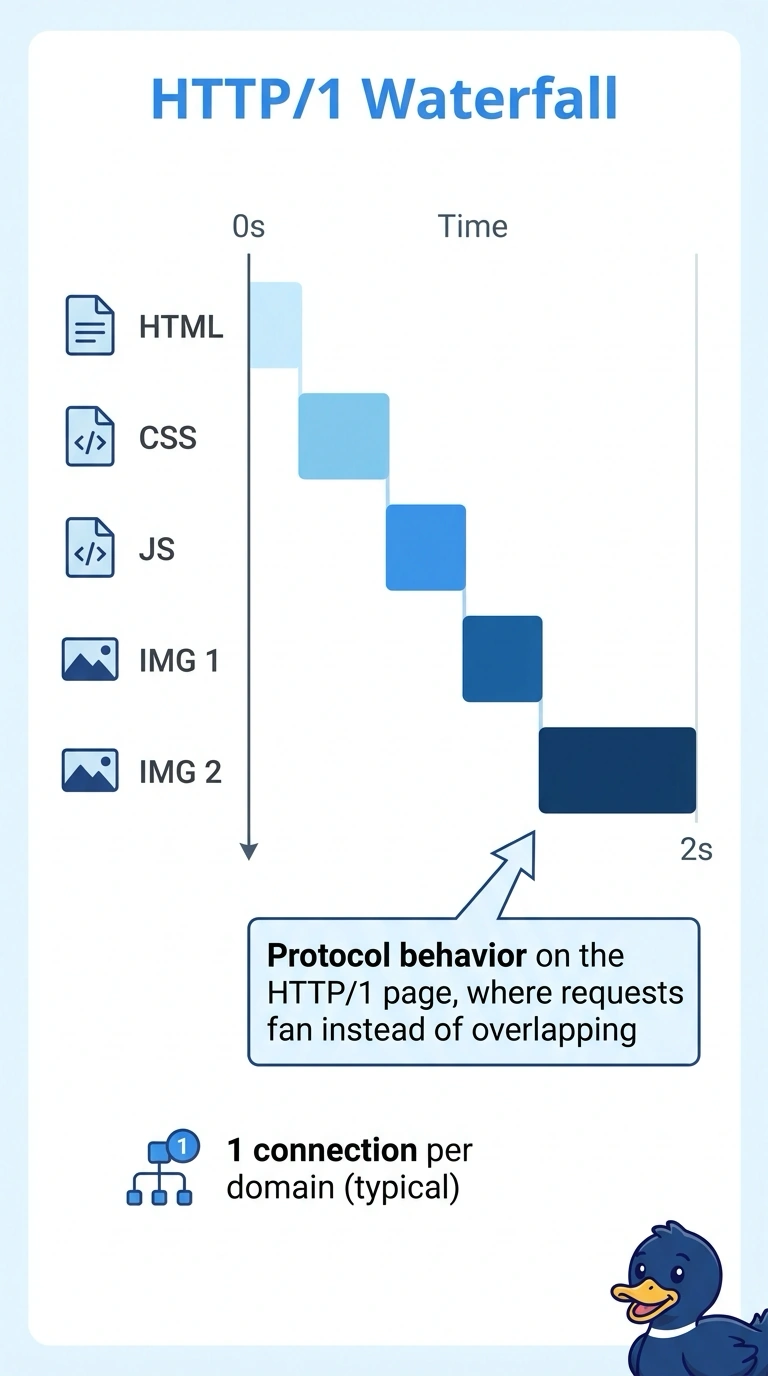
A hotel chain compares two booking sites in browser waterfalls. Requests on the HTTP/1 site fan into a staggered set of bars, while the sister site on HTTP/2 overlaps that same kind of work. Which conclusion fits the HTTP/1 waterfall?
Select an answer to reveal the explanation.
Short Explanation
A single-file doorway stacks people into a line, while a wide lobby lets the same crowd move together. You read the hotel waterfall that fans out as protocol behavior on the HTTP/1 page, because the HTTP/2 sister site overlaps the same kind of work. The trap is a WAN loss alarm, a DNS hijack, or a QoS change for a shape the protocol explains.
Full Explanation
The HTTP/1 booking site shows requests stacked in a fan, each waiting its turn, while the sister site on HTTP/2 overlaps that same kind of work. The contrast is how the protocol on the page schedules requests: HTTP/1 queues them into a staggered waterfall, and HTTP/2 multiplexes them. That shape is protocol behavior on the HTTP/1 page, not a fault that appears only as loss. A WAN loss alarm would show dropped traffic, and it would not neatly explain why the sister site overlaps the same work while this site fans. A DNS hijack would put the name on an unintended host; both sites are the hotel's booking properties, and the chart difference is the request pattern, not a stolen name. A QoS change would be a class-of-service edit, but the staggered bars match request fan-out on HTTP/1, and the HTTP/2 site carrying the same kind of work does not look like a one-site policy problem. Exam caveat: read the shape of the waterfall before you name loss, a hijack, or QoS, especially when a sister page on another protocol does not fan the same way. Operational check: compare the two waterfalls side by side and confirm the HTTP/1 bars wait their turn while the HTTP/2 bars overlap, before you open a path or QoS ticket.