
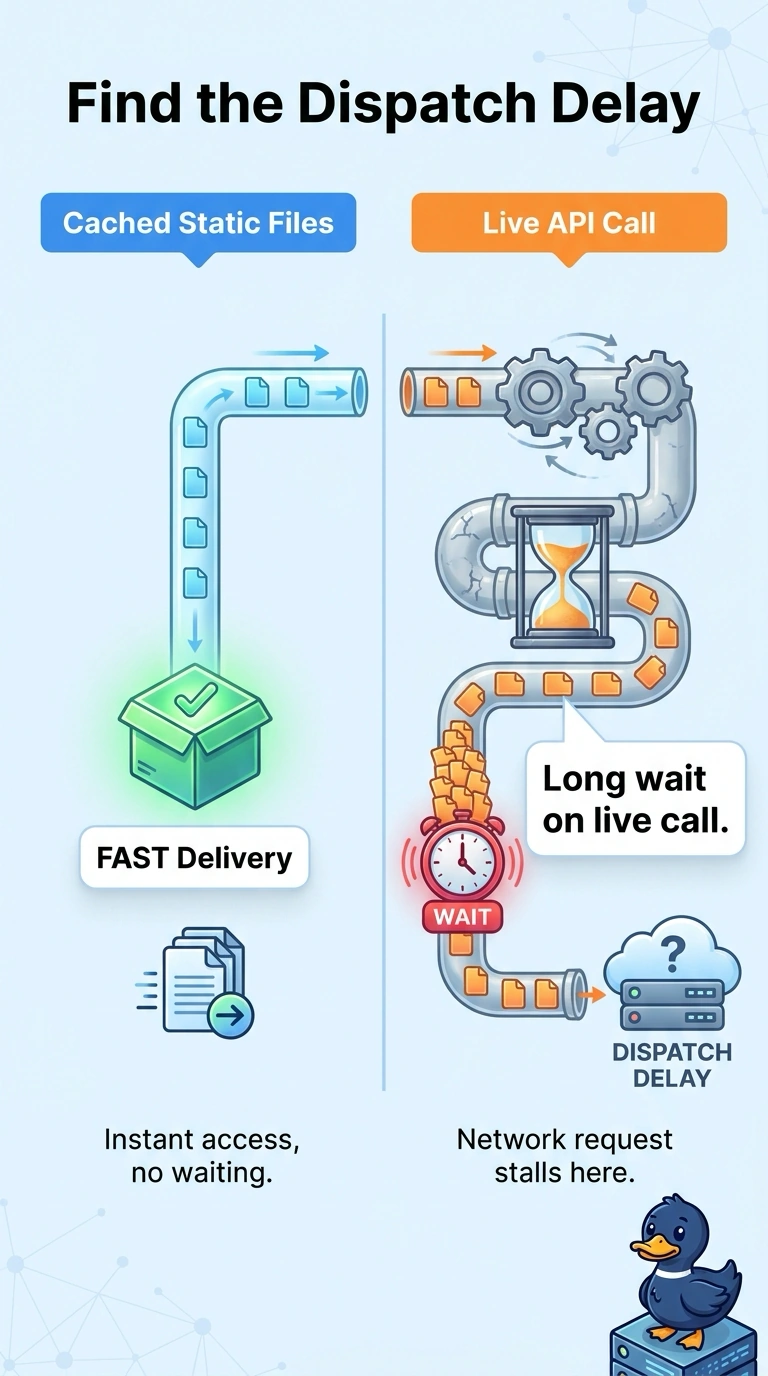
At a logistics hub, the dispatch waterfall shows a long wait on the live API call while the static files are served from cache. What should the analyst treat as the delay?
Select an answer to reveal the explanation.
Short Explanation
You can focus on the part of the waterfall that is actually keeping you waiting: the long wait on the live API call. The cached static files are not the slow part, so treat the API wait as the delay. A WAN loss alarm, a DNS hijack inferred from that wait, or a QoS change aimed at the cached files does not address what the waterfall shows.
Full Explanation
The long wait on the live API call is the delay to treat because the dispatch waterfall shows that request still waiting, while the static files are served from cache. The cached files are therefore not the time the user is spending. A loss alarm raised against the WAN link that feeds the logistics hub would fit evidence of loss on that path; a cached file plus a waiting API call does not establish such loss. A DNS hijack of the dispatch hostname inferred from the API wait mistakes application delay for evidence that the name was redirected. A hijack requires the name to resolve somewhere unintended, which the slow API response alone does not show. A QoS change on the hub edge aimed at traffic for the cached static files targets objects already served from cache and leaves the waiting API call untouched. Exam caveat: cache hits are a reason to stop blaming those objects, while the remaining long wait still needs an owner. Practical check: in the dispatch waterfall, mark the static files as cache hits and the API call as the long wait, then assign that API wait to the service owner before opening a WAN loss, DNS hijack, or edge QoS action.