
On event days at a stadium, one point-of-sale client fails when it uses IPv6, IPv4 tests from that client succeed, and neighboring clients that use IPv6 are fine. What should the team investigate?
Select an answer to reveal the explanation.
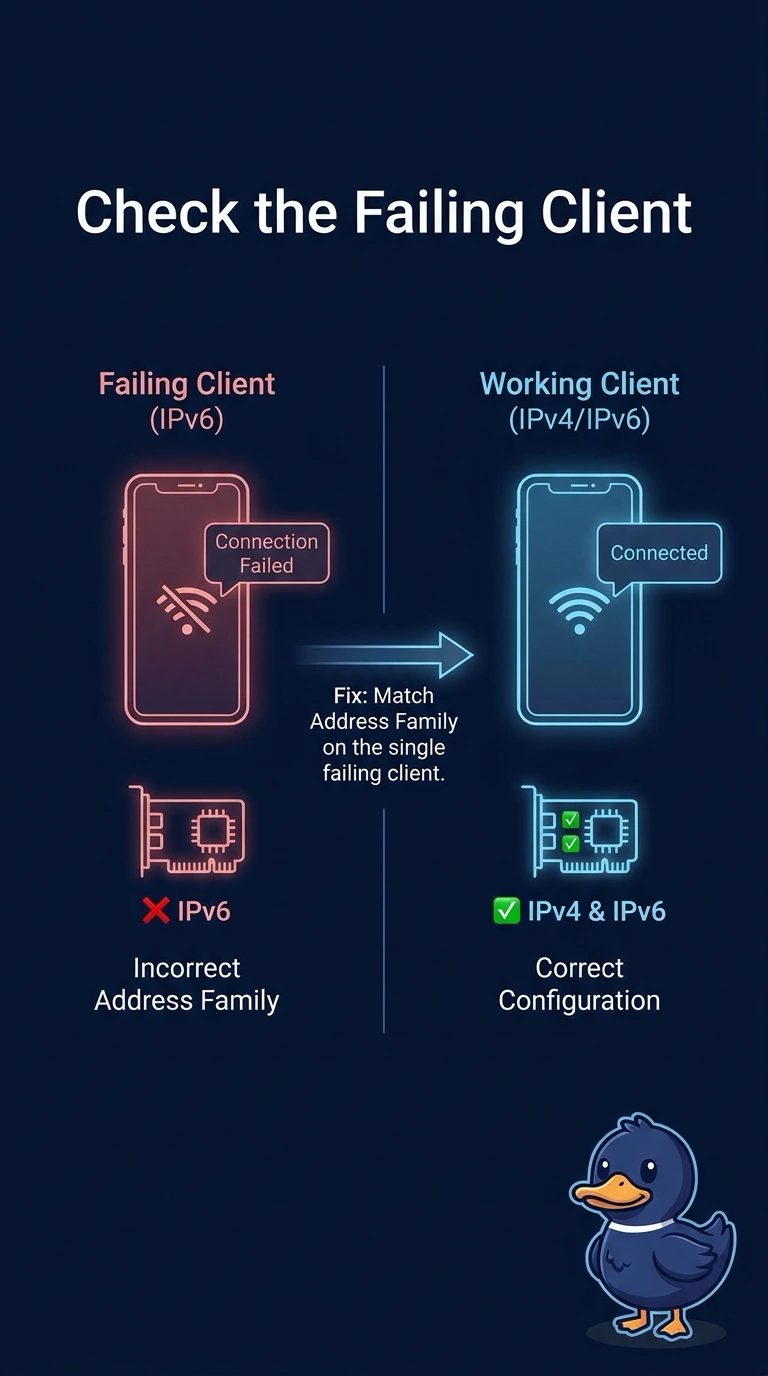
Short Explanation
One bulb in a two-bulb lamp is dark, and the lamp beside it is fine, so you check that bulb. This client fails on IPv6 while its own IPv4 tests pass and neighboring clients using IPv6 are fine, which points to that endpoint's address family. A circuit swap, a routing alert, or a data-center probe move would touch clients that are already working.
Full Explanation
One point-of-sale client fails when it uses IPv6, IPv4 tests from that same client succeed, and neighboring clients using IPv6 are fine, so the investigation is that endpoint's address family. A shared venue path problem would show up on the neighbors that also use IPv6, and IPv4 success from the same client shows it can still reach the destination on the other family. Replacing the stadium WAN circuit is a shared-path action aimed at clients that are not failing. A BGP alert for a route problem at the venue edge describes a routing change that would not spare the neighboring IPv6 clients. Moving the data-center Enterprise Agent off its current host changes a remote probe and leaves the failing client's address family as it is. The exam trap is treating one client's IPv6 failure as a circuit or routing incident after other IPv6 clients at the counter have already passed. In production, from the failing client compare an IPv6 attempt and an IPv4 attempt to the same destination, then repeat the IPv6 attempt from a neighboring client that is working. If the neighbor succeeds on IPv6 and this client does not, keep the work on that client's address family.