
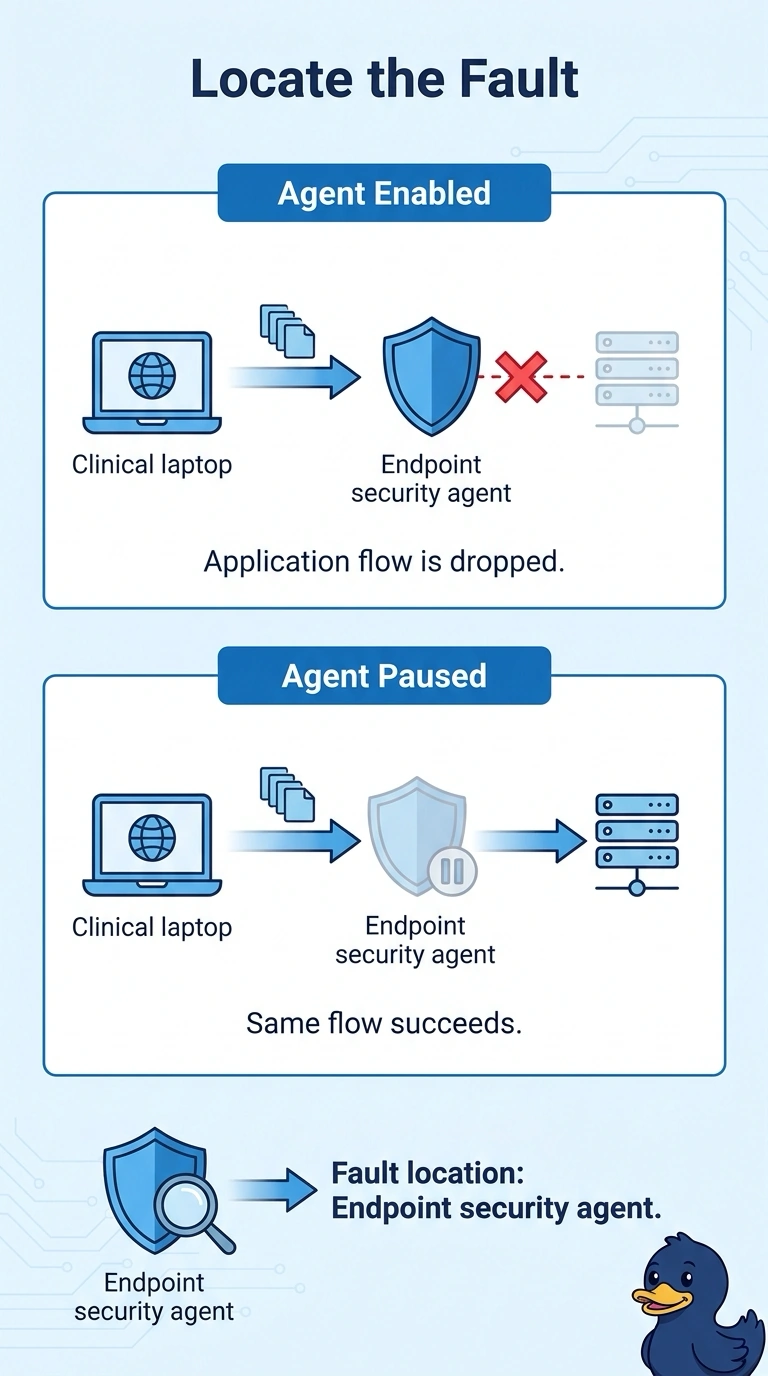
On a hospital campus, a clinical laptop drops an application flow only while a local security agent is enabled, and the same flow succeeds when that agent is paused. Where is the fault?
Select an answer to reveal the explanation.
Short Explanation
The lock on the laptop is dropping the package, and the road in front of you is open. The flow dies only while the local security agent is enabled and succeeds when that agent is paused, so you treat the endpoint as the fault. A circuit replacement, a routing alert, or a data-center probe move does not track that pause.
Full Explanation
The clinical laptop drops the application flow only while a local security agent is enabled and passes the same flow when that agent is paused, so the fault is the agent on the endpoint. The pause holds the path constant and changes the endpoint control, which is the signature of a local drop rather than a WAN failure. The WAN circuit between the campus and the application host is still carrying the flow during the successful pause, so replacing that circuit does not match the evidence. A BGP alert looks for a provider route change, and the flow returns when the agent is paused without a routing change. The placement of an Enterprise Agent inside the data center affects a remote probing point and does not enable or pause the laptop security agent. The exam trap is escalating an endpoint control into a circuit replacement because the application host is off campus. In production, enable and pause the security agent while watching the same flow, and confirm the drop appears and clears with the agent while the path is left unchanged. A route alert or a data-center probe move can wait until a failure remains after the agent is paused.