
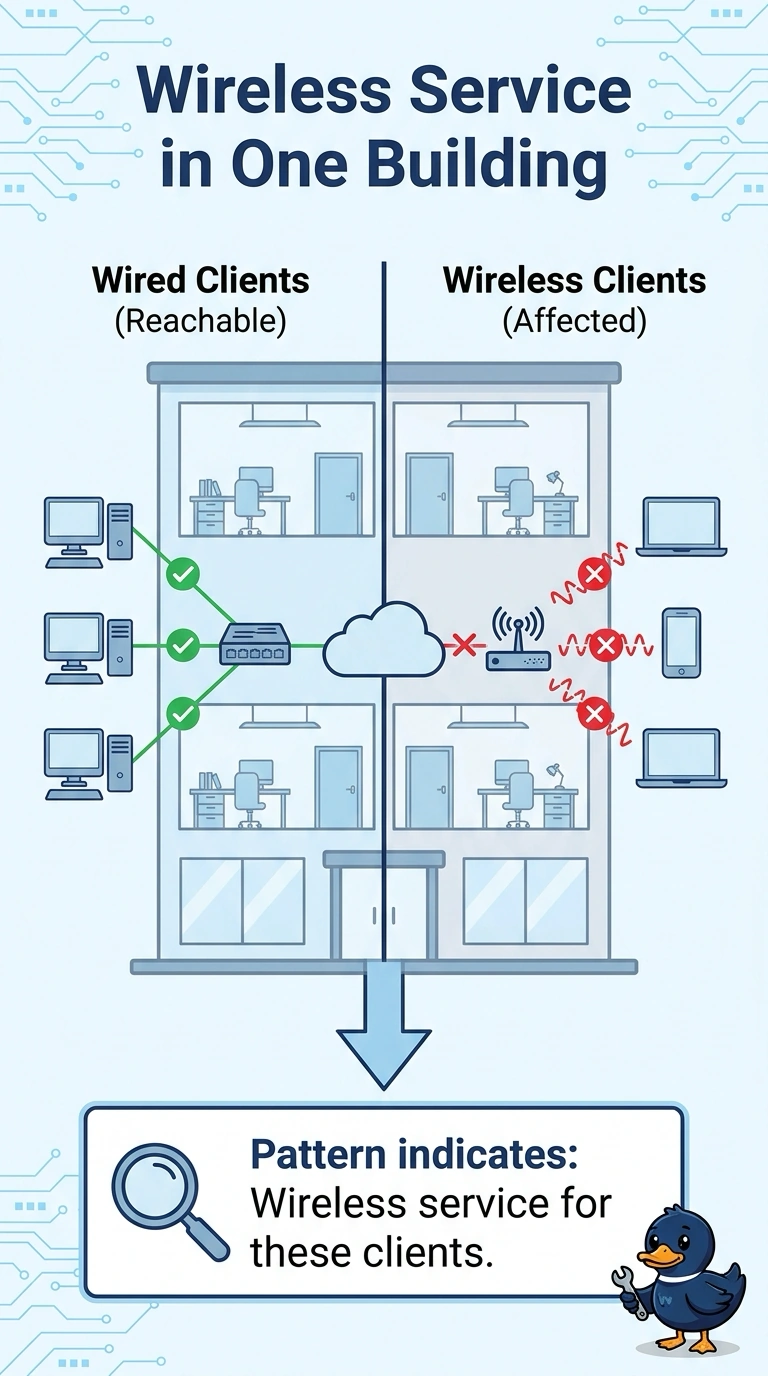
At a government agency, trouble reports cluster on wireless clients in one building, while wired clients in that same building stay reachable. What does that pattern indicate?
Select an answer to reveal the explanation.
Short Explanation
One floor of lights is dark and the rest of the building is bright, so you check that floor's lamps. The pattern points to wireless in the affected building, because wired clients there stay reachable. A circuit replacement, a route-leak alert, or a data-center probe move describes a fault this evidence does not show.
Full Explanation
Complaints that cluster on wireless clients in one building, while wired clients in that building stay reachable, share the wireless attachment and not the building's upstream circuit. A fault on the WAN circuit serving the building would be expected to affect wired and wireless clients that share that circuit. A BGP route leak at the internet edge would reach clients by routing, not by whether they associated to wireless in one building. Moving the data-center Enterprise Agent to another site changes where a remote probe sits and does not explain a wireless-only pattern in one building. The exam trap is promoting a local wireless cluster into a routing leak or a circuit failure because those incidents sound larger. In production, compare wireless clients and wired clients in that building toward the same destination, and confirm the failures stop at the wireless attachment. If wired clients in the same building keep reaching the destination, leave the circuit and the internet-edge routes off the first work list. The data-center probe can stay where it is until a fault actually shows up beyond that building's wireless service.