
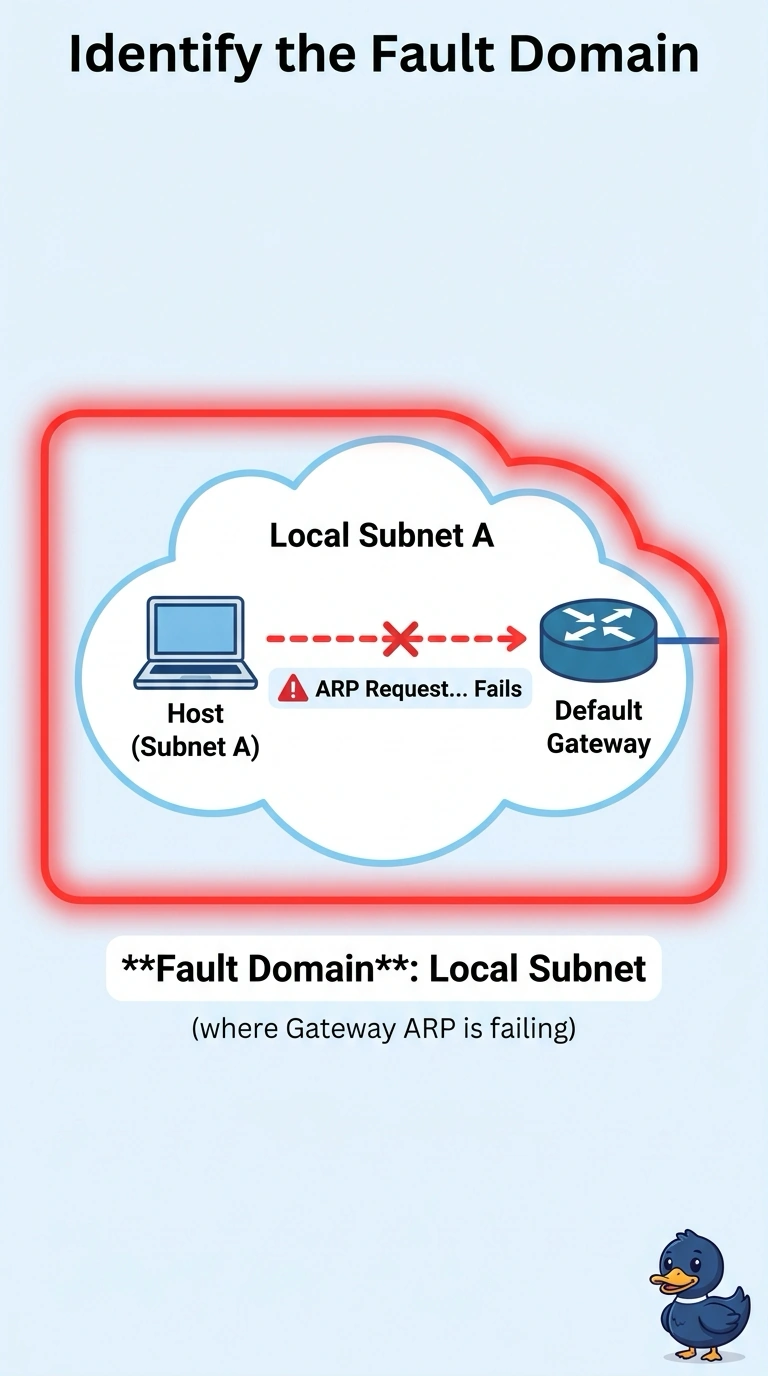
On one hotel subnet, hosts cannot complete ARP for the default gateway, and only devices on that subnet lose connectivity. What should the team treat as the fault domain?
Select an answer to reveal the explanation.
Short Explanation
If the doorbell on one floor cannot find its button, you do not repave the street. Gateway ARP failing on that hotel subnet means the fault is the local network, before traffic can leave the floor. A circuit swap, a routing alert, or a data-center probe move all assume the packet already got off the subnet.
Full Explanation
Hosts that cannot complete ARP for the default gateway do not build a frame to the next hop, so the fault domain is the local network on that subnet. Only devices on that subnet lose connectivity, which matches a local gateway problem and not a shared upstream path. Replacing the hotel WAN circuit would address a path beyond the gateway, and hosts that cannot resolve the gateway are not reaching that circuit. A BGP session alert at the provider edge describes routing between autonomous systems, which this subnet does not use to resolve its own gateway address. Moving the data-center Enterprise Agent to a different rack changes a remote probing point and does not restore ARP on the hotel subnet. The exam trap is opening an upstream circuit or routing incident for a failure that stops at local address resolution. In production, from a host on the failing subnet, check whether ARP for the gateway resolves, and compare that result with a host on a subnet that still works. If the working subnet resolves the gateway and the failing subnet does not, keep the work on that local network.