
At a manufacturer, docking a laptop changes the path metrics, and a capture shows the flow leaving on a different NIC than it used before the dock. What does that evidence identify?
Select an answer to reveal the explanation.
Short Explanation
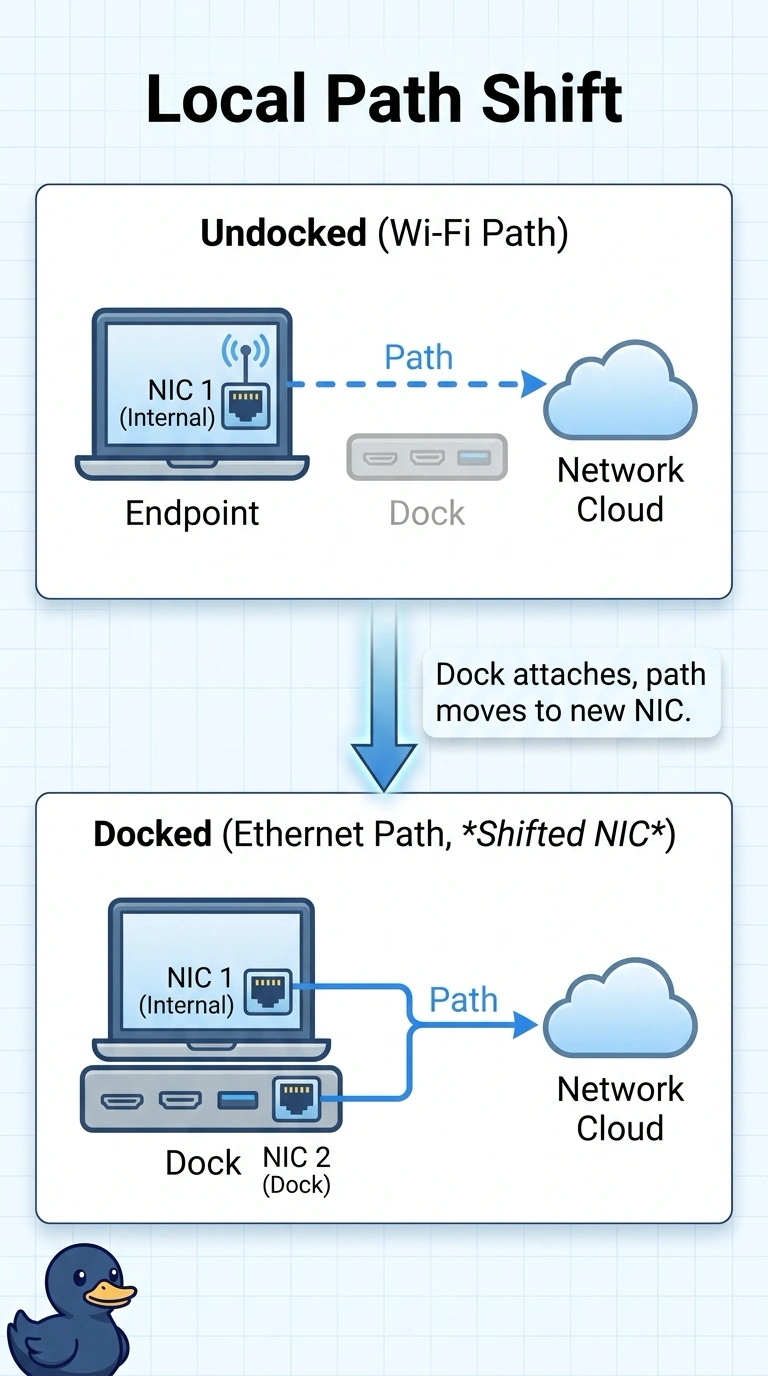
A dock is a second driveway, and your laptop just started leaving by that driveway instead of the old one. You are looking at the endpoint local path, because the flow moved to a different NIC when the dock attached. A plant-edge routing change would not swap NICs inside the laptop.
Full Explanation
Docking the laptop changes the path metrics, and the capture shows the flow leaving on a different NIC than before. That is the endpoint choosing a new local path, so the evidence identifies the local path on the laptop rather than a fault beyond the host. A WAN circuit fault would show up on traffic after it left the laptop, and it would not by itself move the flow from one NIC to another inside the host. A BGP change at the plant edge is a routing event upstream of the laptop, and docking does not rewrite plant-edge advertisements or swap the NIC the host transmits on. Moving a data-center Enterprise Agent nearer the application changes a remote probe and leaves the laptop transmitting on the NIC the dock selected. Exam caveat: a metric shift that begins at the moment of docking is a local-path clue, and it should be tied to the interface change before anyone replaces a circuit. Operational check: capture on both NICs while docking and undocking, and confirm the flow follows the NIC change rather than a shift in the plant-edge routing table.