
A university security policy must block specific HTTPS URL paths, not only the host name. The current URL filter sees only the name. Which change lets the policy see the path?
Select an answer to reveal the explanation.
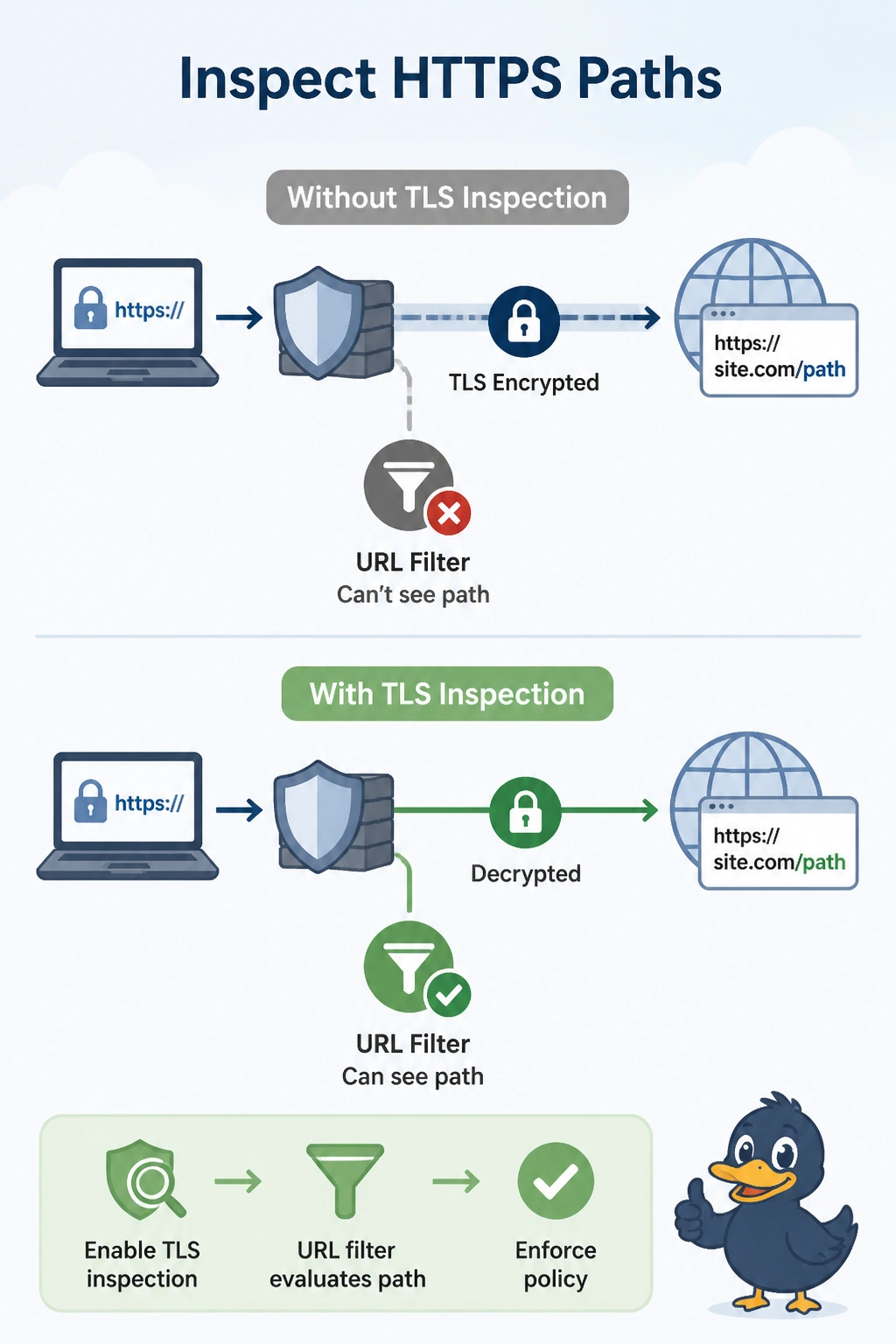
Short Explanation
The envelope shows the building, and the rule you want is about a room inside it. You enable TLS inspection in the security policy so the URL filter can see the path, not only the host name. A routing preference does not open the envelope.
Full Explanation
Without TLS inspection, a URL filter on Catalyst SD-WAN can often see only the host name exposed during the handshake. The path inside an HTTPS request stays encrypted. Enabling TLS inspection in the security policy lets the filter evaluate that path and block the specific URLs the university named. Raising OMP preference changes which TLOC is chosen. It does not decrypt HTTP. Shortening a loss target changes when application-aware routing is unhappy. It does not decrypt anything. Cloud OnRamp for Multicloud attaches a private cloud network. It is not a TLS proxy for branch HTTPS. Exam caveat: TLS inspection has to be limited to the traffic the policy is allowed to decrypt, and it needs the certificate setup the security policy documents. Turning it on for every flow can break pinned applications. Operational check: a request to a blocked path on a test site should be dropped and logged, while a request to the same host and a permitted path should pass.