
A secure internet gateway accepts IKE only from one agreed public address. The campus NAT pool uses a different public address, and IKE never completes. The gateway address is reachable. What should change?
Select an answer to reveal the explanation.
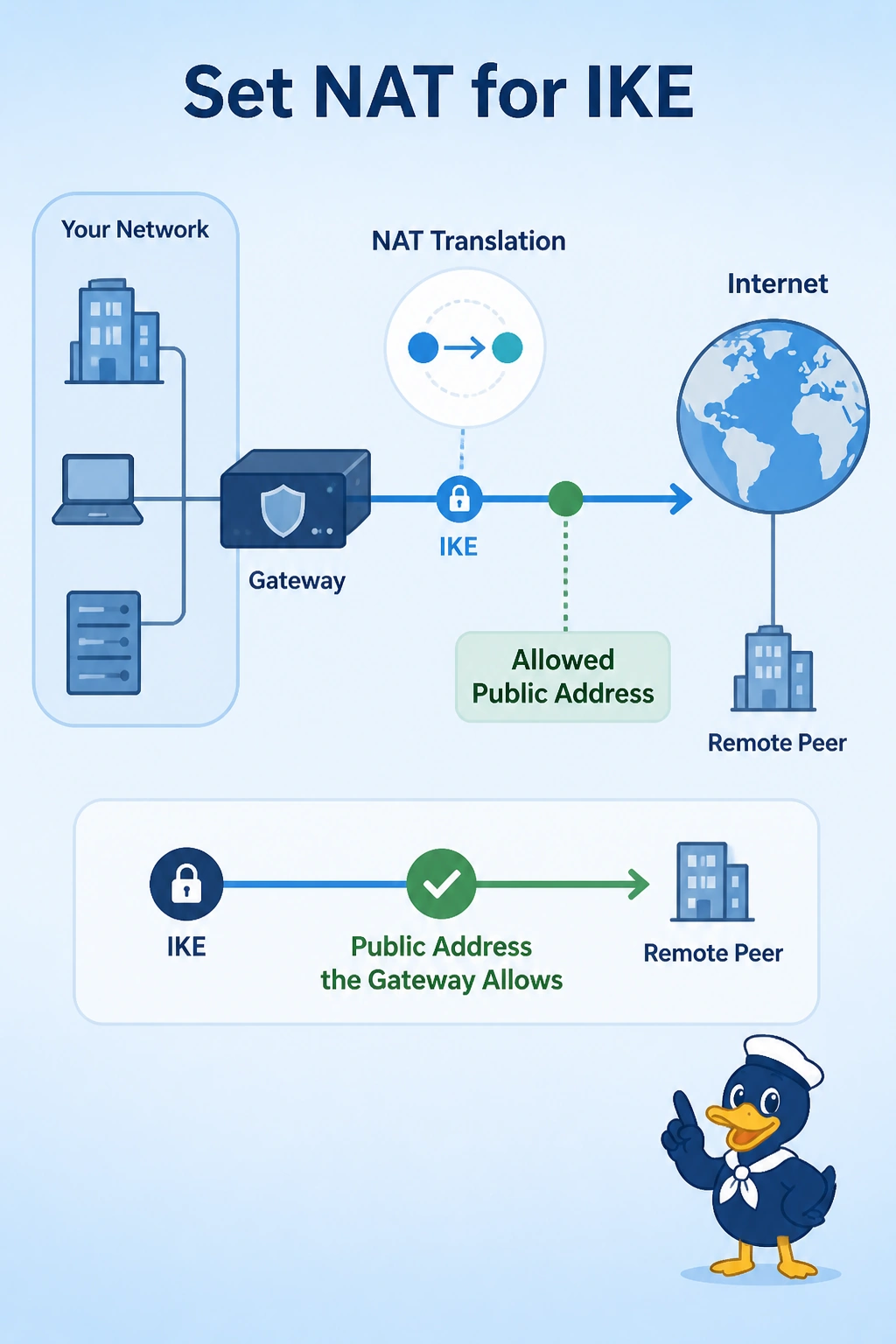
Short Explanation
You’re knocking with the wrong return address. Change the NAT translation so IKE leaves from the public address the gateway already allows. Since you can reach the gateway, the issue is not the OSPF area or the tunnel number; neither is the IKE source allow list.
Full Explanation
The secure internet gateway checks the public source address it sees for IKE. Your campus NAT pool uses a different public address from the one the gateway allows, so IKE cannot complete even though the gateway address is reachable. Change the NAT translation so IKE leaves from the public address the gateway already permits. The OSPF area on the SIG does not need to equal the NAT pool: an OSPF area is not an IKE source-address allow list. The BGP hold timer is also unrelated; the SIG does not copy it into an IKE allow list. The campus router’s tunnel number does not have to match before the gateway checks the source address. Exam caveat: matching the allowed source is necessary, but UDP 500 and UDP 4500 must also be permitted; a correct source address will not bypass a firewall rule blocking those ports. Practical check: capture traffic outside NAT and confirm IKE packets are leaving toward the SIG with the allowed public source address, then verify that the tunnel comes up.