
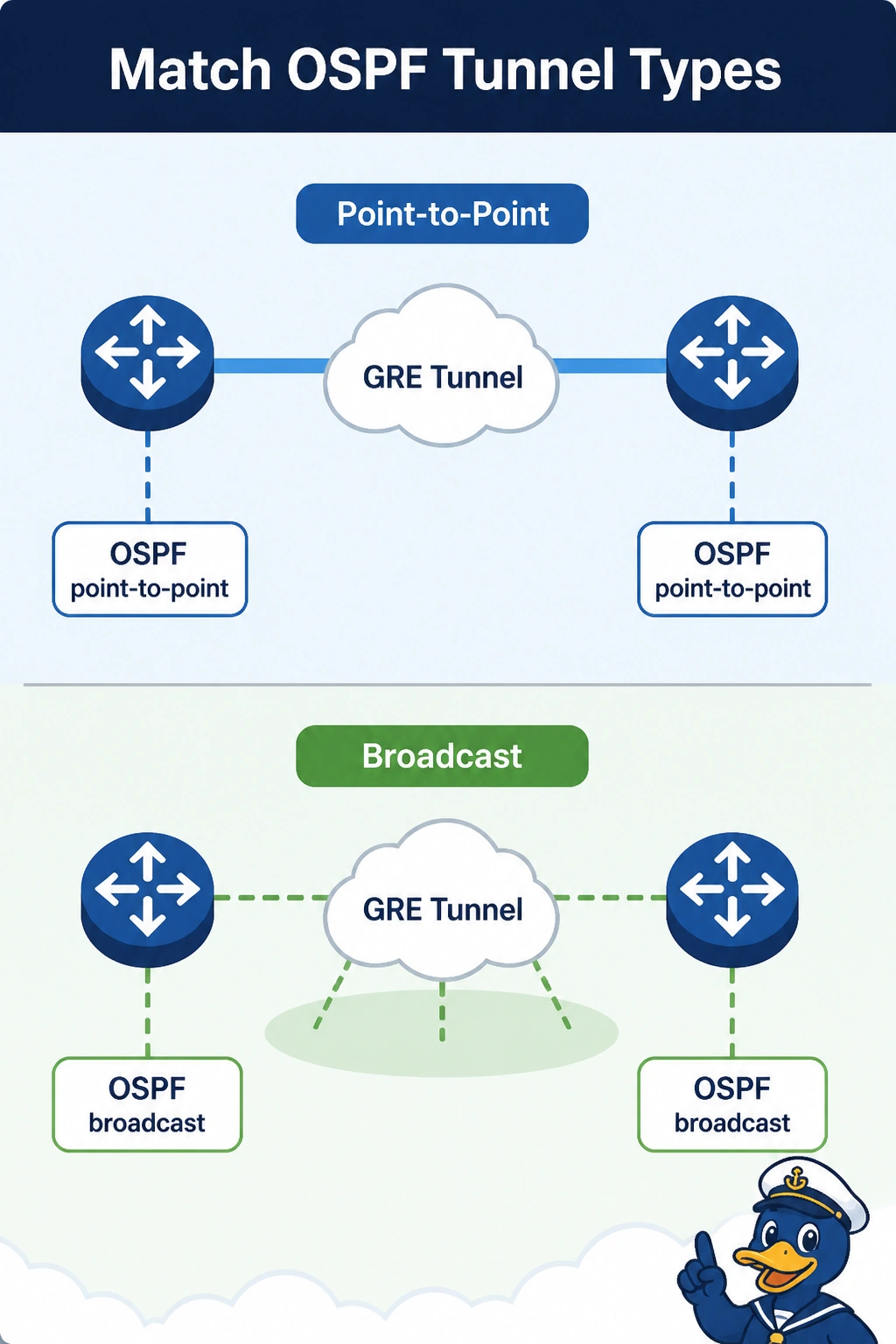
Campus and cloud Cisco IOS XE routers run OSPF on a GRE tunnel. One side is network type point-to-point and the other is broadcast. Hellos arrive and the adjacency never forms. What must match?
Select an answer to reveal the explanation.
Short Explanation
Both ends have to agree what kind of wire this is. You set the same OSPF network type on both tunnel interfaces. Hellos are already arriving, so IKE is not the problem, and a virtual private gateway is not the device on the other end of this GRE tunnel.
Full Explanation
OSPF will not form an adjacency when the neighbors disagree on the network type. Point-to-point and broadcast expect different hello behavior and different designated-router roles, so hellos can arrive while the adjacency stays down. Set both tunnel interfaces to the same type, usually point-to-point on a two-router GRE tunnel. The IKE version is not blocking hellos. The stem says hellos arrive, so the tunnel is passing OSPF. The AWS virtual private gateway does not terminate this GRE tunnel. Both ends are IOS XE routers the customer operates, and that gateway does not use a BGP ASN to complete an OSPF handshake. An SD-WAN site ID is not an OSPF area, and these routers are not described as SD-WAN edges. Exam caveat: matching the network type is not a substitute for matching the area, the timers, and the MTU. If the next symptom is EXSTART, check MTU next. Operational check: show ip ospf interface tunnel on both routers should list the same network type, and show ip ospf neighbor should move to Full.