
A campus IOS XE router has two up BGP sessions to AWS across two tunnels. The team wants this router's outbound traffic to prefer tunnel 1. Which local change does that?
Select an answer to reveal the explanation.
Short Explanation
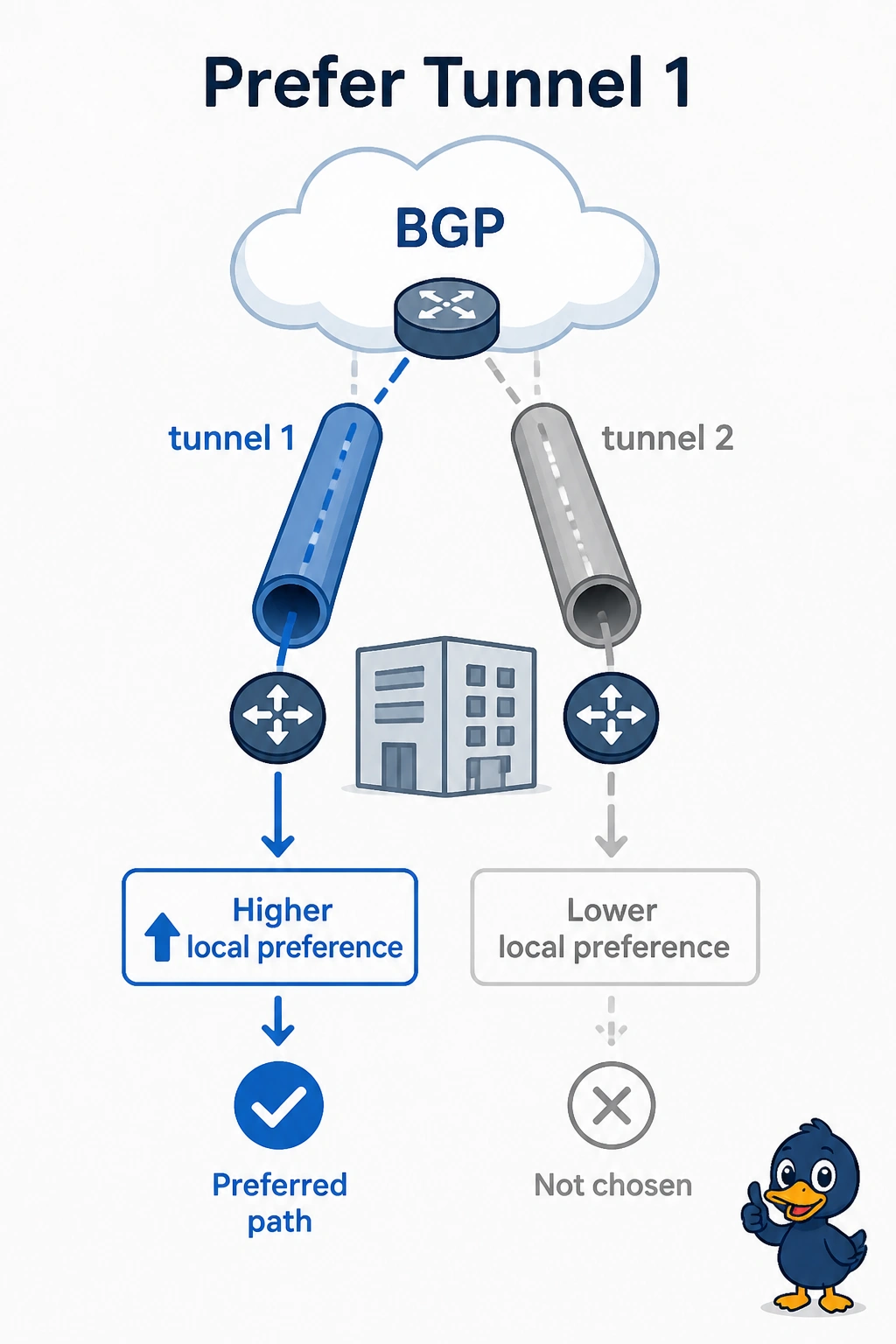
Outbound is your own choice, made with local preference. You raise local preference on the routes learned from tunnel 1, and this router sends traffic that way. MED is a hint you hand to the other side, so it does not pick your own exit, and AWS is not running OSPF on these sessions.
Full Explanation
Local preference is the BGP attribute the local router uses to choose among routes to the same prefix. A higher local preference on the prefixes learned from the tunnel 1 neighbor makes tunnel 1 the outbound path while both sessions are up. MED is advertised to influence how the neighbor comes back. Setting a higher MED toward AWS does not choose this router's outbound tunnel. It asks AWS to prefer a return path, and higher MED is actually less preferred. OSPF cost does nothing here. The sessions are BGP to AWS, and the virtual private gateway is not an OSPF neighbor. The IKE lifetime changes when the security association rekeys. It is not a routing preference, and a shorter lifetime does not attract outbound packets. Exam caveat: local preference picks the exit on this router. Inbound from AWS still follows what you advertise, such as AS-path prepending, if the return path matters too. Operational check: show ip bgp for the VPC prefix should list the tunnel 1 neighbor as best, with the higher local preference, and a trace should leave on tunnel 1.