
Two Cisco IOS XE routers, one on campus and one in a VPC, run OSPF over a protected GRE tunnel. Hellos arrive. One side is in area 0 and the other is in area 1. The adjacency stays down. What must match?
Select an answer to reveal the explanation.
Short Explanation
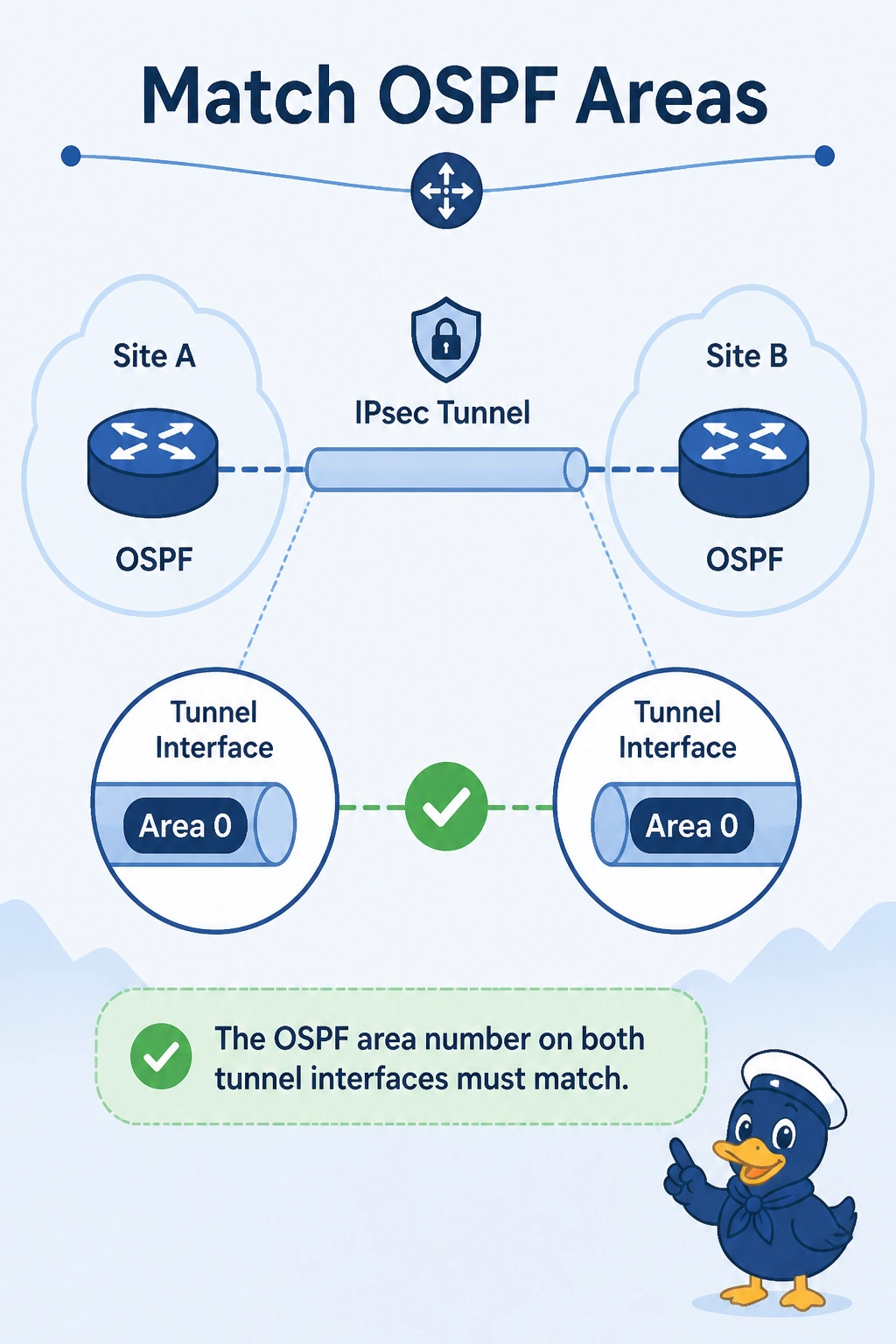
OSPF will not become neighbors across an area line drawn in the middle of one wire. You put both tunnel interfaces in the same area. Hellos are already arriving, so IKE is done, and a virtual private gateway is not the router on the far end of this tunnel.
Full Explanation
OSPF hellos carry the area ID. Neighbors that disagree on the area do not form an adjacency, even when the packets arrive and the tunnel is up. Put both tunnel interfaces in the same area. On a simple two-router overlay that is usually area 0 on both ends, or the same non-backbone area on both ends if this link does not need to be the backbone. The IKE version is not the failure. Hellos arriving means the protected GRE tunnel is passing OSPF. The virtual private gateway does not terminate this GRE tunnel and does not supply a BGP ASN for the adjacency. MTU problems show up after the neighbors reach EXSTART. An area mismatch never gets that far, so changing MTU does not fix the area field. Exam caveat: matching the area is still not matching the network type or the authentication key. If the area is corrected and the adjacency stays down, check those next. Operational check: show ip ospf interface tunnel on both routers should list the same area, and show ip ospf neighbor should then show the peer.