
A hospital has one ExpressRoute circuit in one peering location. The private path must survive the loss of that location. What adds that survival?
Select an answer to reveal the explanation.
Short Explanation
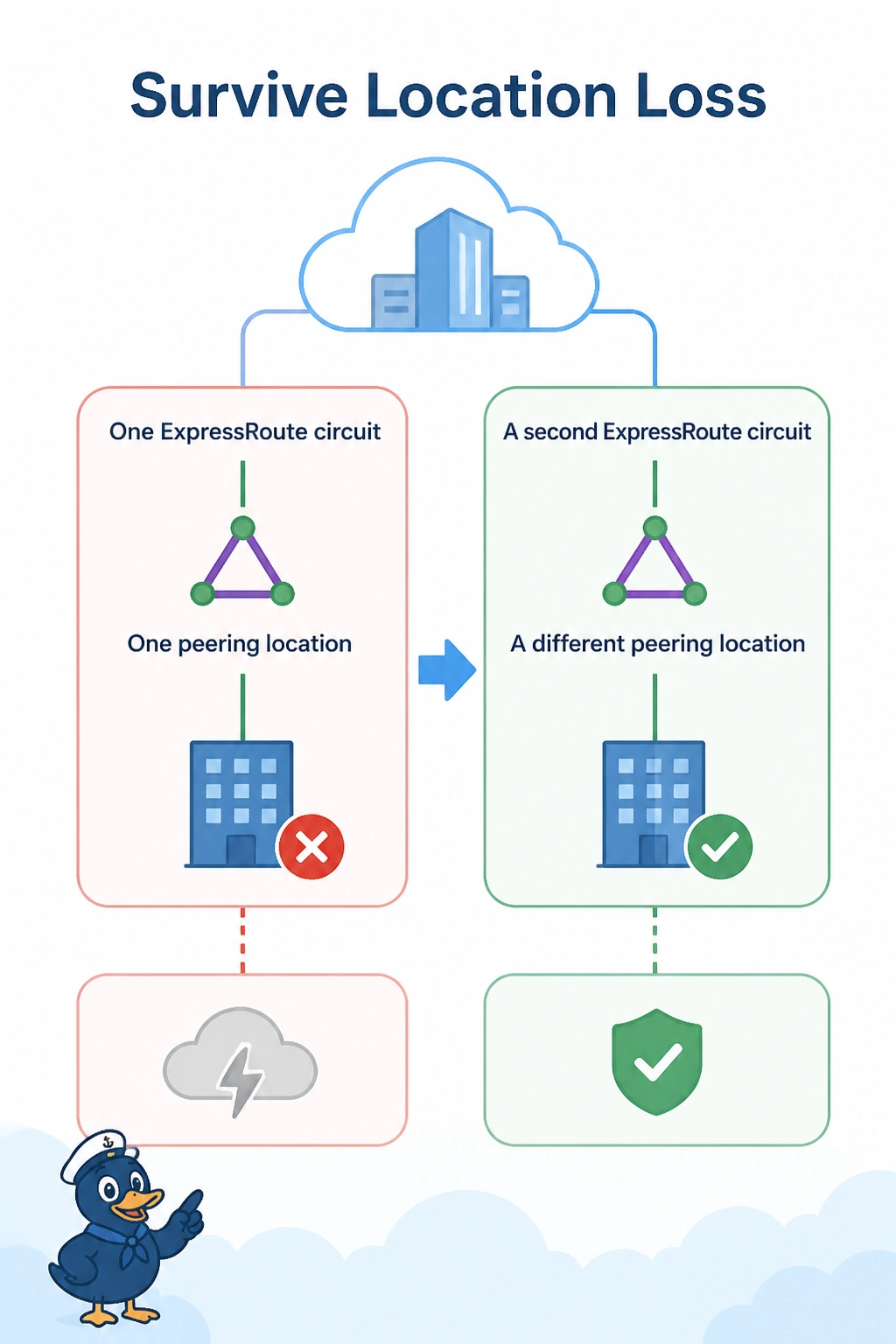
You need location diversity: a second ExpressRoute circuit in a different peering location can keep the private path available if the first location fails. A second BGP session or a static route to the same provider edge shares that failure, and a longer IKE lifetime cannot help when the internet VPN does not exist.
Full Explanation
An ExpressRoute circuit is tied to its peering location, so surviving the loss of that location requires a second ExpressRoute circuit in a different peering location that can carry the virtual-network prefixes. A second BGP session on the same circuit does not add location diversity; it still depends on the original location and fails with it. A second static route pointing at the same provider edge has the same limitation: the route still leads through the original location. A longer IKE lifetime on an internet VPN does not provide private-path survival here, because that VPN does not exist and changing its lifetime would not create another ExpressRoute location. Exam caveat: the second circuit needs its own private peering into the virtual networks; buying the circuit without configuring peering does not move traffic. Practical check: shut down the first circuit and confirm that the hospital still reaches the virtual networks through the second peering location.