
While troubleshooting, a Python script fetches a single device from an SD-WAN Manager REST endpoint by UUID and receives HTTP 404 with a JSON body reporting that the device cannot be found. The same request with a valid UUID returns HTTP 200, and the session was created earlier in the same job. Which interpretation of the 404 response is correct?
Select an answer to reveal the explanation.
Short Explanation
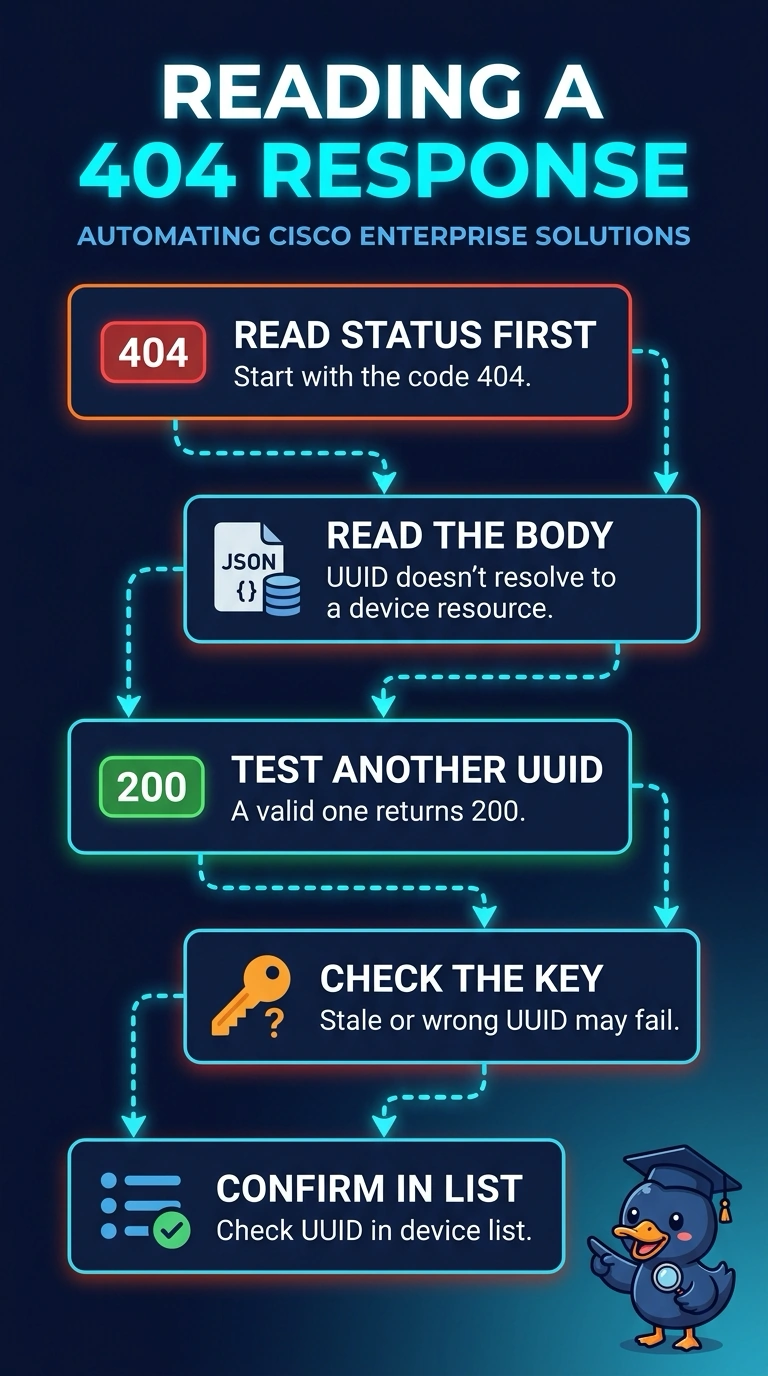
You can read the 404 and its JSON body as indicating that the UUID does not resolve to a device resource available through this endpoint on this controller. Since a valid UUID returns 200 in the same session, a general session or endpoint-access problem is unlikely; check the UUID against the device list.
Full Explanation
A 404 from the SD-WAN Manager (formerly vManage) API means the requested path or identifier did not resolve to a resource available through that request; a JSON body saying the device cannot be found supports that interpretation. The queried UUID may be stale or mistyped, the device may have been removed from inventory, or the request may target the wrong controller or tenant. An expired session token is less consistent with the evidence: the session was created earlier in the same job, and a valid UUID returns HTTP 200 on that session. A general account-permission failure is also unlikely, because the request succeeds for a valid UUID; however, success does not establish access to every resource. A disconnected device is not, by itself, what this 404 response establishes: the response concerns whether the device resource resolves through this endpoint, not whether the device is currently connected. As an exam caveat, API behavior can vary by endpoint and release, and a 404 alone does not prove that the device exists nowhere or rule out resource-specific access restrictions. As a practical check, query the collection endpoint and confirm that the UUID appears in the relevant device list on the same controller before retrying the single-resource call.