
A customer is deploying 60 access switches across branches. The design has only a DHCP scope and a local config server, and each switch must pull its first configuration by itself at boot, with all traffic staying inside the customer network. Which Day 0 bootstrap method fits every stated requirement?
Select an answer to reveal the explanation.
Short Explanation
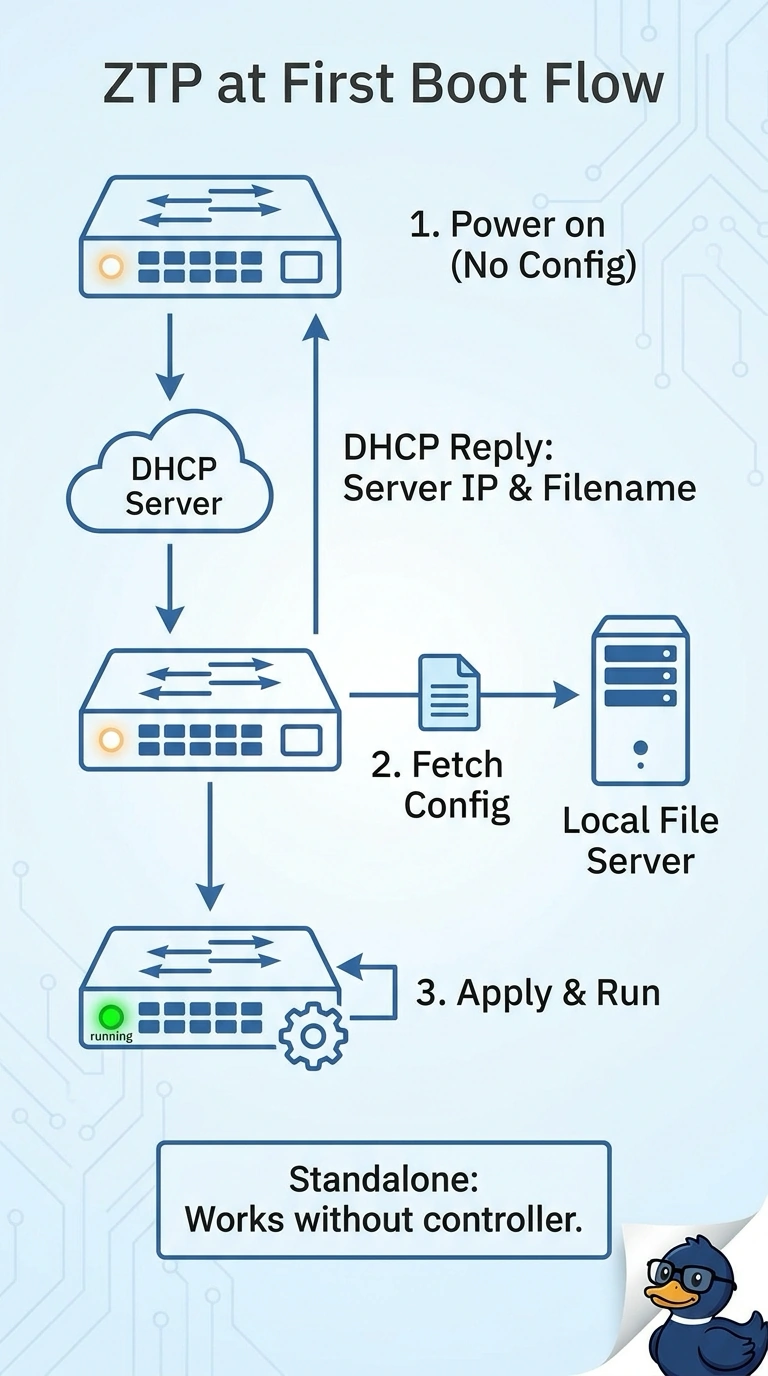
With just DHCP and a file server in the design, you're counting on the switch to help itself. ZTP does exactly that: DHCP hands over a file name and the switch pulls its own config at boot. It's the classic bootstrap for fleet rollouts.
Full Explanation
ZTP is the fit because the stated DHCP scope can direct each switch to the existing local configuration server, allowing the switch to obtain its initial configuration at boot without an external service or controller push. USB provisioning is a legitimate way to stage branch switches and can keep all data local, but it requires someone to connect media and load the configuration; the switch does not pull its first configuration by itself at boot. An Ansible push from a local controller is also common for automating device configuration and keeps traffic on the customer network, but the controller initiates the configuration session after the switch is reachable, rather than the switch pulling its own first configuration. On-premises PnP can support automatic boot-time discovery and keep traffic local, but it requires a dedicated PnP controller; the stated design provides only a DHCP scope and a local configuration server. Exam caveat: product terminology and discovery mechanisms vary, so verify whether a platform’s PnP implementation can use the specified server or requires a separate controller. Practical check: confirm the DHCP scope supplies the correct server address and that a factory-default switch can reach the server and retrieve its first configuration entirely within the customer network.