
Your team is writing a Python script that provisions a new branch office in the Meraki Dashboard org. The script already holds an API key and the organization ID, and the site needs an MX appliance plus MS switches. Which JSON body should the create-network request send for the Dashboard to accept it?
Select an answer to reveal the explanation.
Short Explanation
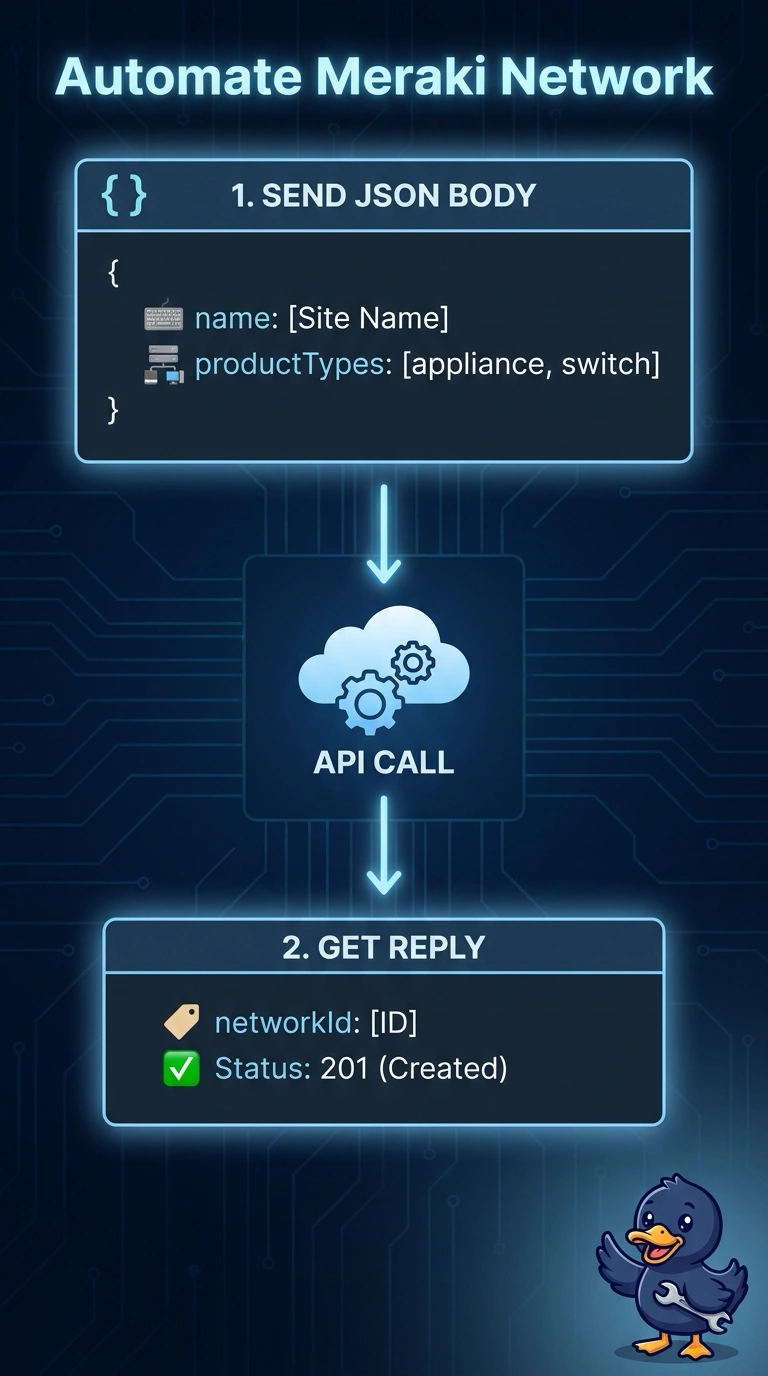
You’ve got it—the Dashboard needs name and productTypes in the JSON body, and the product declaration is easy to overlook. Think of booking a hotel room: you provide the name and room type on one form before anyone hands over a key.
Full Explanation
The create-network request needs name to identify the network and productTypes to specify the product families it will manage. For an office with an MX appliance and MS switches, the JSON body should use the documented family values appliance and switch. A body containing name, timeZone, and tags leaves out the required product declaration; time zone and tags are optional metadata, not substitutes for productTypes. Sending name and productTypes as form-encoded fields also fails because the endpoint expects a JSON request body. Using the hardware strings mx and ms is a schema error: productTypes expects family values such as appliance and switch, rather than model-family abbreviations. Exam caveat: distinguish the product-family values accepted by the API from the names of the hardware being installed. As a practical check, test the script against a scratch organization and confirm the response includes a new network ID before using it in production.