
A team scripts SD-WAN Manager to standardize NTP settings: create a feature template, refine it after review, then apply it to 60 routers while tracking rollout status per device. Which sequence of configuration API operations does the script need?
Select an answer to reveal the explanation.
Short Explanation
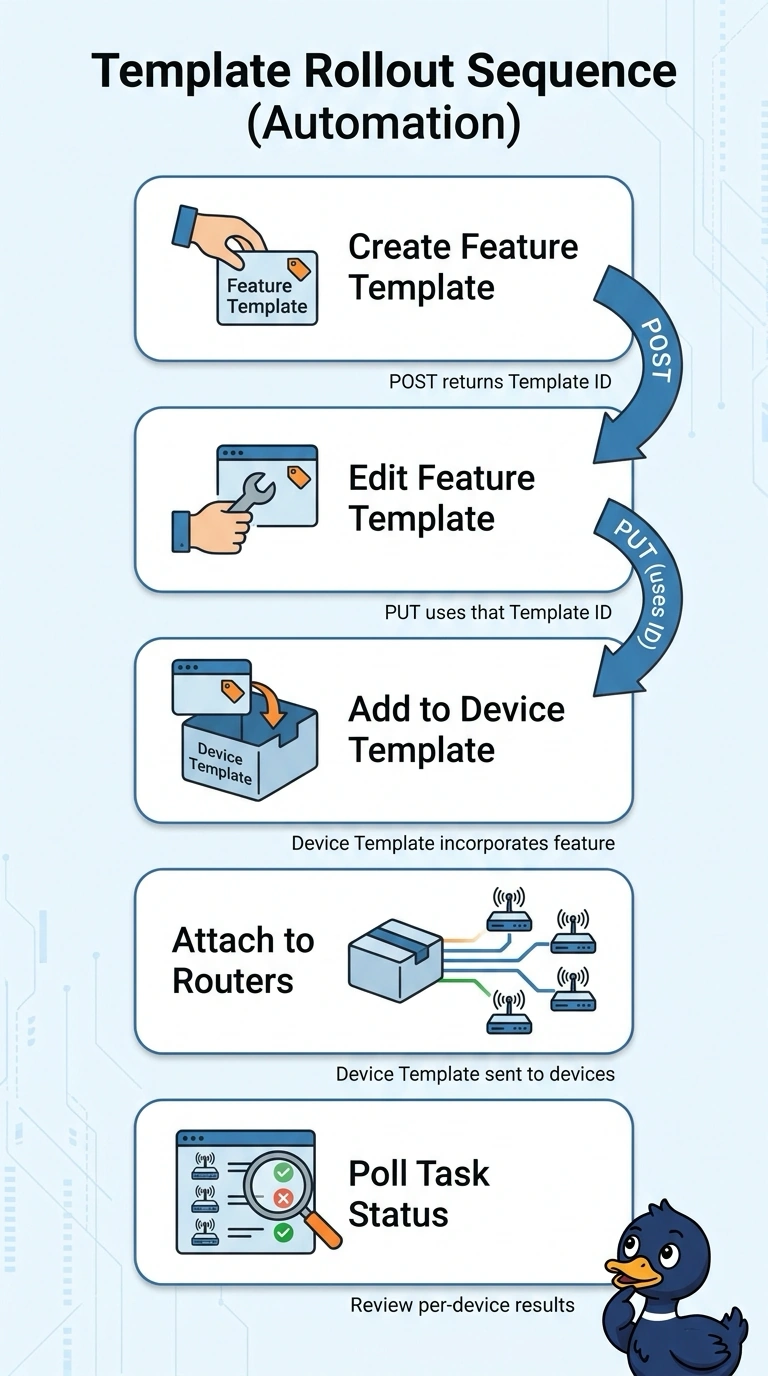
You’ll POST the feature template, PUT your reviewed changes, add it to the device template, and attach that template to your 60 routers. Then poll the returned task to follow rollout status for each device.
Full Explanation
The required workflow preserves the reviewed NTP configuration and provides visibility into an asynchronous rollout. POST creates the feature template, and PUT applies the refinements made after review. Add the feature template to a device template, attach that device template to the routers, and poll the returned task to track per-device progress. Posting the template and deploying it without a PUT omits the reviewed changes, so the refinements are not applied to the configuration being deployed. Polling only for overall task completion is insufficient because the requirement is to track status separately for each device; an aggregate result can conceal individual failures or delays. Checking each router’s running configuration afterward can help validate the result, but it does not replace polling the deployment task to follow rollout status. Exam caveat: task identifiers and response fields can vary across SD-WAN Manager versions, so distinguish task-level completion from device-level results rather than assuming one guarantees the other. Practical check: confirm the task response maps all 60 target devices to statuses and that the script handles failures or timeouts before reporting success.