
A network team is standing up a new building's fabric through Catalyst Center's SDA APIs from a Python pipeline. Wired endpoints there must land in the corporate overlay, and each call returns a task that has to finish before the next call runs. Which SDA provisioning sequence should the pipeline execute?
Select an answer to reveal the explanation.
Short Explanation
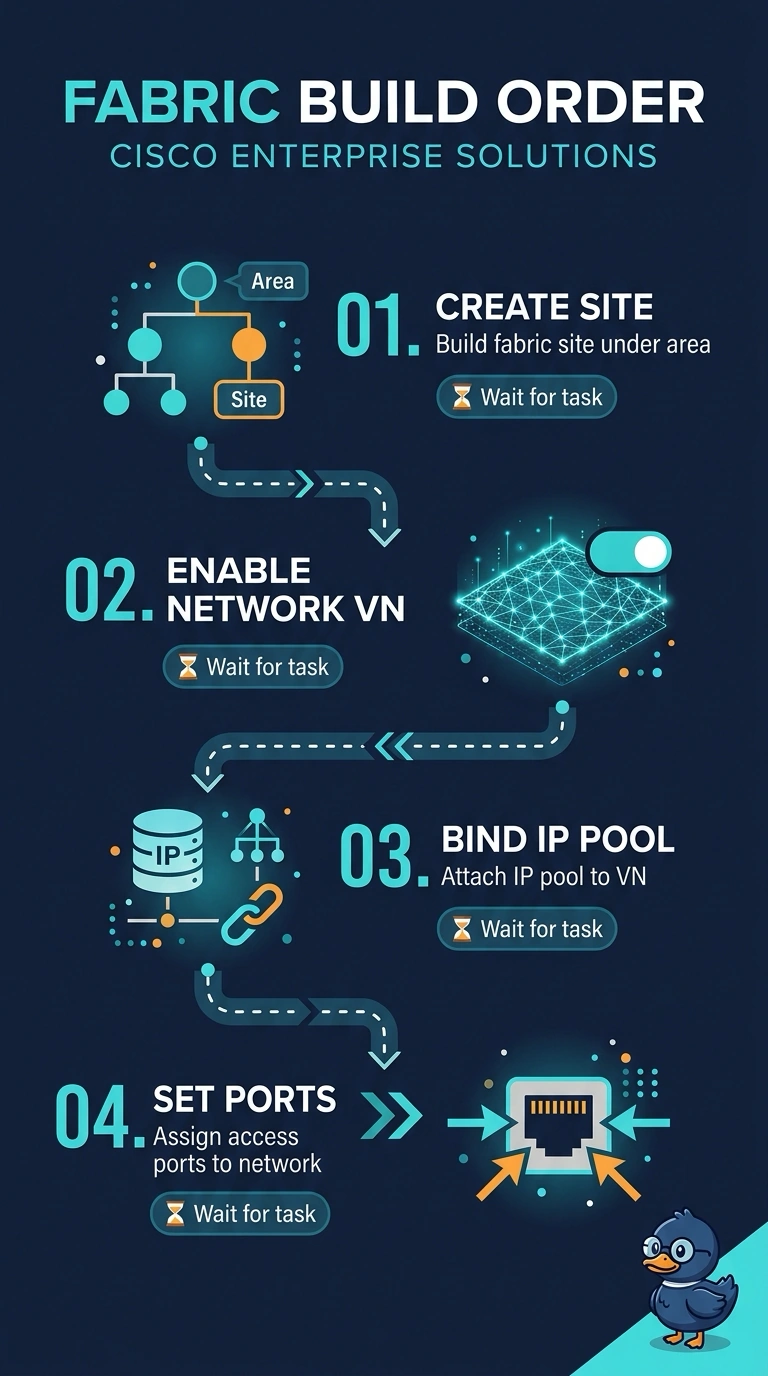
Fabric work follows a build order, a bit like pouring the slab before you frame the walls. You create the site, switch on the virtual network there with an IP pool, then point each access port at it, and poll each returned task before proceeding.
Full Explanation
Catalyst Center builds fabric through a hierarchy of areas and sites, and a virtual network needs to be enabled at the site that owns those ports and backed by an IP pool to serve wired endpoints. Only then does assigning an access port to that virtual network place the endpoint in the corporate overlay. Poll each returned task to completion before proceeding to the next API call. Creating the virtual network first and the site last fails the site-scoping rule, because without the fabric site in place there is no context in which the network can be enabled for those ports. Assigning ports straight to an IP pool fails the overlay requirement, since a pool is only address space and gives no segmentation or fabric membership. Converting access switches into border nodes fails the node-role rule, because access nodes serve access ports while border nodes link the fabric to outside networks, and a role change assigns no endpoint to a virtual network. Exam caveat: API payloads and newer workflow naming evolve between releases, so confirm the schema you are calling. Practical check: poll each task to completion, then read the port assignment back to verify the virtual network and pool.