
A university is rolling out SD-Access fabric across six buildings and wants NOC staff to get fabric health alerts while netops automates virtual networks and host pools consistently. Central policy and wired host onboarding must stay unified. Which statement describes Catalyst Center events with SD-Access automation?
Select an answer to reveal the explanation.
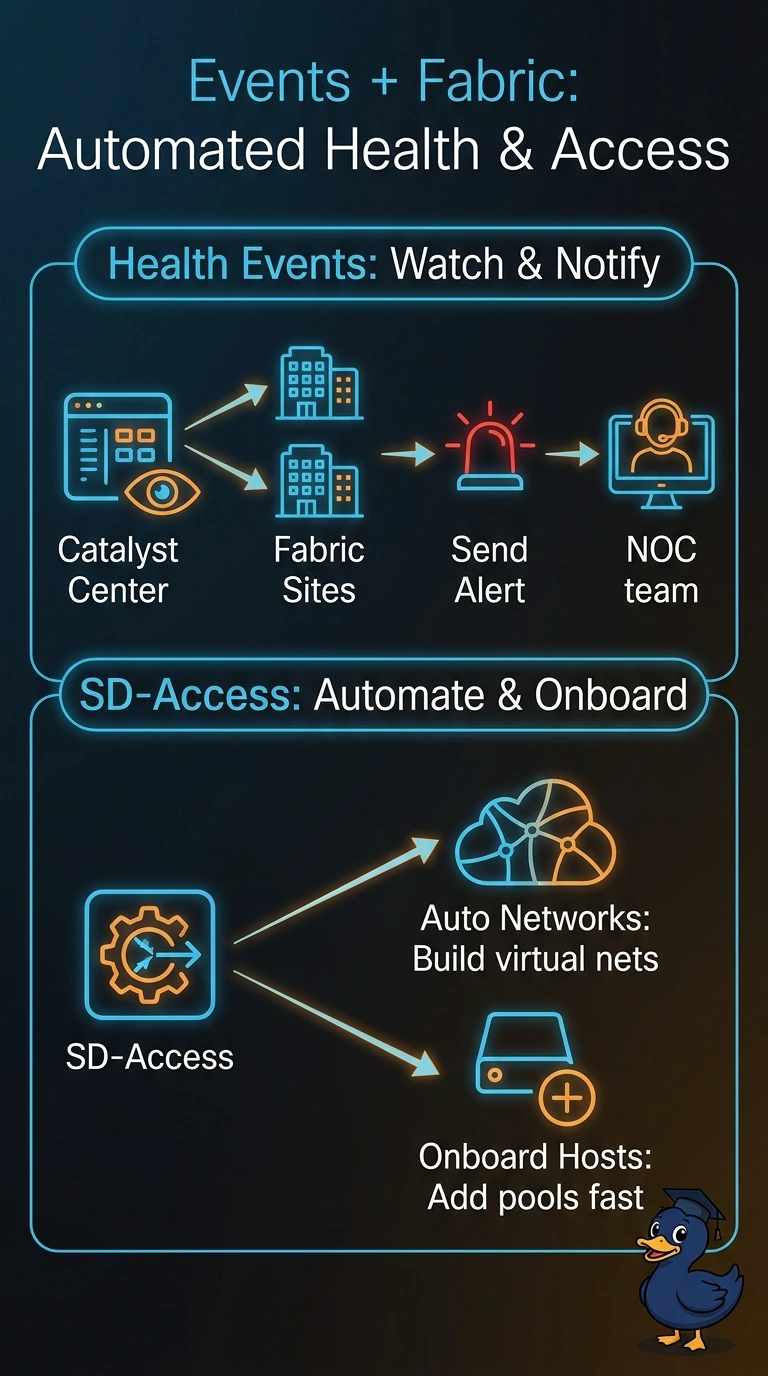
Short Explanation
You're tying alerts to action, which is pure campus gold. That fabric-aware combo keeps health signals and policy moves in one neat loop.
Full Explanation
The correct statement matches both sides of the requirement: Catalyst Center assurance events provide fabric-health notifications for NOC staff, while SD-Access workflows provide the coordinated way to automate virtual networks and wired host onboarding. This keeps the automation aligned with centralized policy rather than creating separate configuration paths across six buildings. The streaming-telemetry approach can provide useful health alerts and retains SD-Access automation and centralized policy, but it substitutes device telemetry for the specifically requested Catalyst Center assurance-event subscription. The Ansible approach uses assurance events and can apply virtual-network and host-pool settings consistently, yet applying templates outside SD-Access policy workflows creates a separate control path and does not preserve unified central policy. The separate-NAC approach retains assurance events and SD-Access virtual-network automation, but moves wired onboarding to an independently managed policy system, so wired host onboarding is no longer unified with central fabric policy. Exam caveat: an external tool or NAC platform may integrate with Catalyst Center; integration alone does not mean the requested onboarding and policy workflows remain unified. Practical check: verify in Catalyst Center that assurance-event subscriptions target the NOC and that the intended virtual networks and wired host onboarding are provisioned through the fabric workflows and centrally managed policy.