
A service-desk engineer is building one Python tool for a 40-site SD-WAN fabric managed by SD-WAN Manager. It must disable a departed operator's login, list every edge with serial and software version, show interface alarms from the last hour, and push an updated QoS feature template. Which API family handles each of these four jobs?
Select an answer to reveal the explanation.
Short Explanation
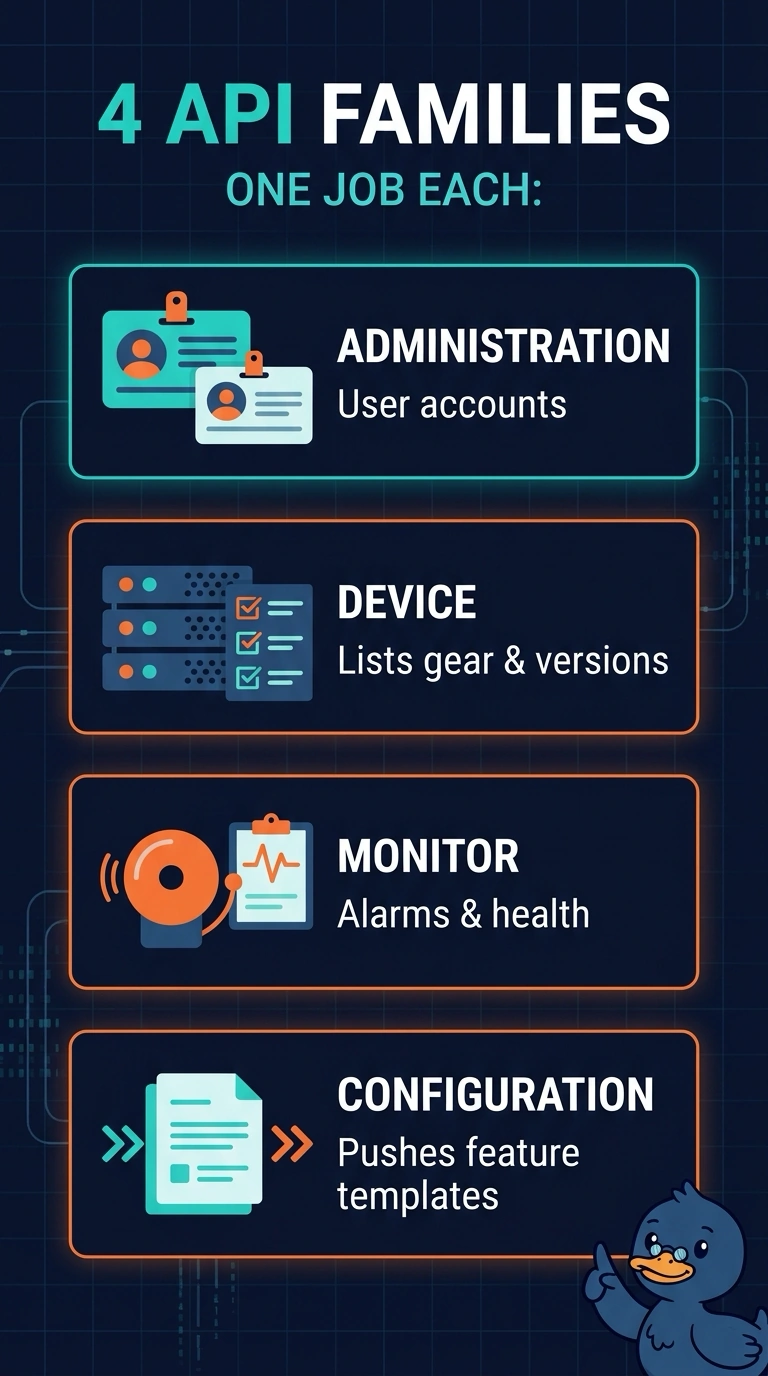
Each SD-WAN Manager job has a home: accounts with administration, inventory with the device family, alarms with monitor, and templates with configuration. It's like a mailroom where every department has its own box. Guess wrong and your call lands on an API that simply does not serve that data.
Full Explanation
SD-WAN Manager (formerly vManage) groups its endpoints into families by the kind of work they do, and each family owns one category of operation. Administration covers identity and access: users, passwords, roles and authentication settings, so disabling a departed operator belongs there. The device family covers device inventory, including device lists, serial numbers and software versions, so the edge inventory query belongs there. Monitor covers telemetry and events, including statistics, alarms, network health and monitoring views, so the interface alarm query belongs there. Configuration covers intent modelling, including feature templates, device templates and policies, so pushing the QoS template belongs there. Sourcing inventory from monitor fails because statistics views are measurements, not an authoritative device record. Sourcing alarms from the device family fails because live telemetry and event streams belong to monitoring. The template push belongs to configuration rather than monitor. One caveat: legacy endpoint paths sometimes hint at older groupings, so a familiar path prefix can mislead you. A practical check: confirm the family label beside the endpoint in the API reference before you call it.