
A manufacturing campus uses all-Cisco Catalyst distribution pairs for office VLANs where one uplink idles in standby, and wired phones need deterministic gateway failover without host changes or multivendor support. Hosts within every VLAN should be spread across both switches behind one virtual IP per VLAN, and tuning for subsecond timers is approved. Which first-hop redundancy choice balances load sharing and simplicity?
Select an answer to reveal the explanation.
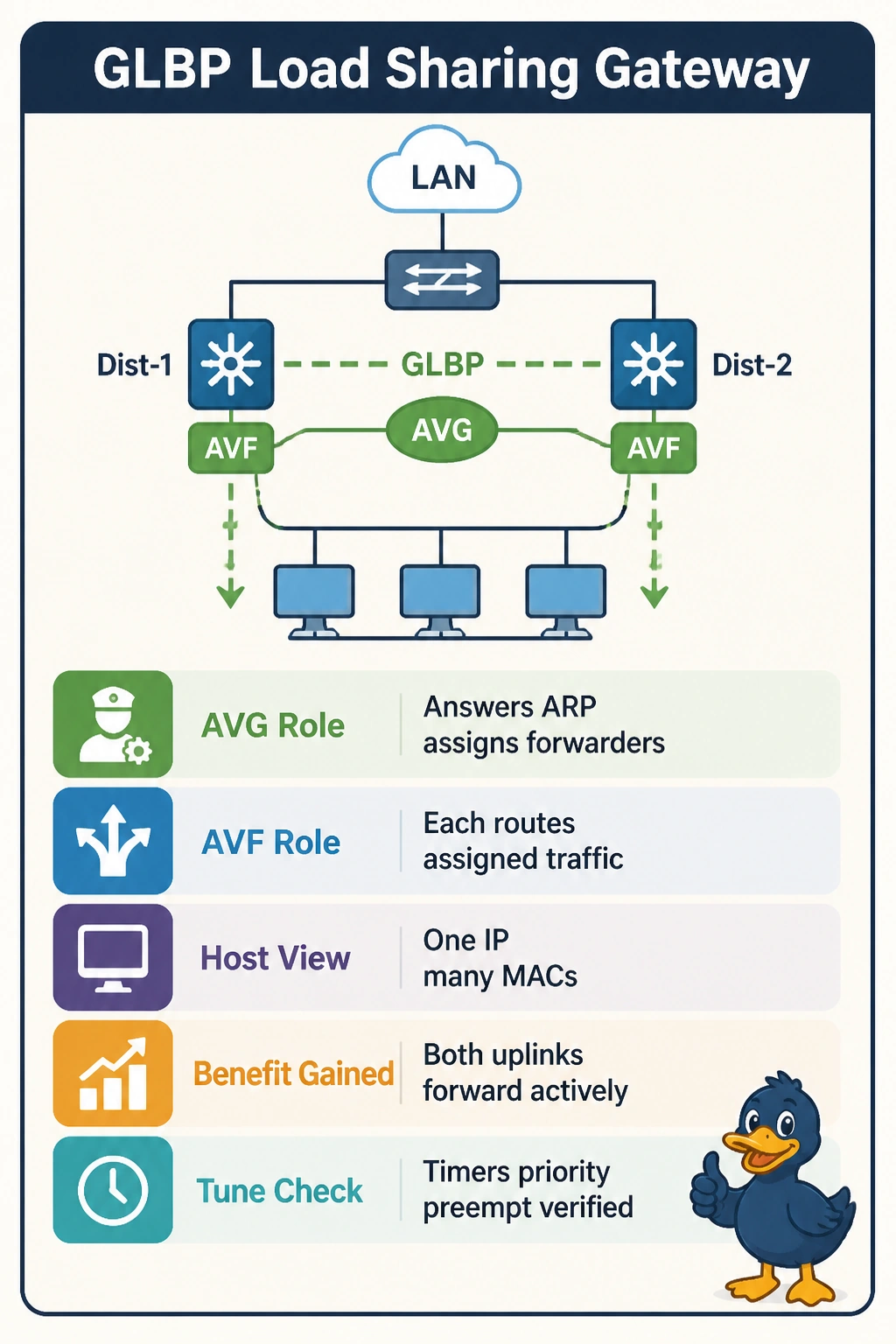
Short Explanation
You're leaving bandwidth on the table with a hot spare, so let both routers cook at once. Load-balancing with GLBP hands out different forwarders while hosts still see one cozy gateway.
Full Explanation
GLBP elects an Active Virtual Gateway that responds to ARP with different virtual MACs owned by Active Virtual Forwarders, so hosts on the same VLAN forward through both distribution switches simultaneously while retaining a single virtual IP, giving active-active use without host changes and Cisco-native timers and tracking for subsecond failover. Single-group HSRP active-standby provides clean Cisco failover and tracking but leaves one uplink idle for that subnet, directly missing the efficient uplink use requirement. Single-group VRRP master-backup adds IETF interoperability that has no value in an all-Cisco design and likewise forwards only through the master, so it wastes capacity while adding no benefit. Manual VLAN-splitting with multiple HSRP groups can use both links across VLANs but cannot spread hosts within a single VLAN, and it doubles groups, ARP logic, and operational mapping per VLAN and fails deterministically if odd-even distribution skews, trading simplicity for fragile administration where GLBP automates distribution. For the exam, link GLBP to Cisco-only load sharing, VRRP to open multivendor need, and HSRP to Cisco simplicity, and in practice verify AVG priority, weighting, and timer tuning with traffic tests before production.