
A global enterprise runs PIM-SM in two regions with separate RPs, needing RP redundancy inside each region and shared group sources across regions without single-point failure. Interdomain source discovery must remain loop-free. Which MSDP with anycast RP design meets the redundancy requirement?
Select an answer to reveal the explanation.
Short Explanation
You need local resilience plus cross-region gossip. Anycast RP plus MSDP is like local mayors backed by pen pals, keeping RPs close while sharing sources safely.
Full Explanation
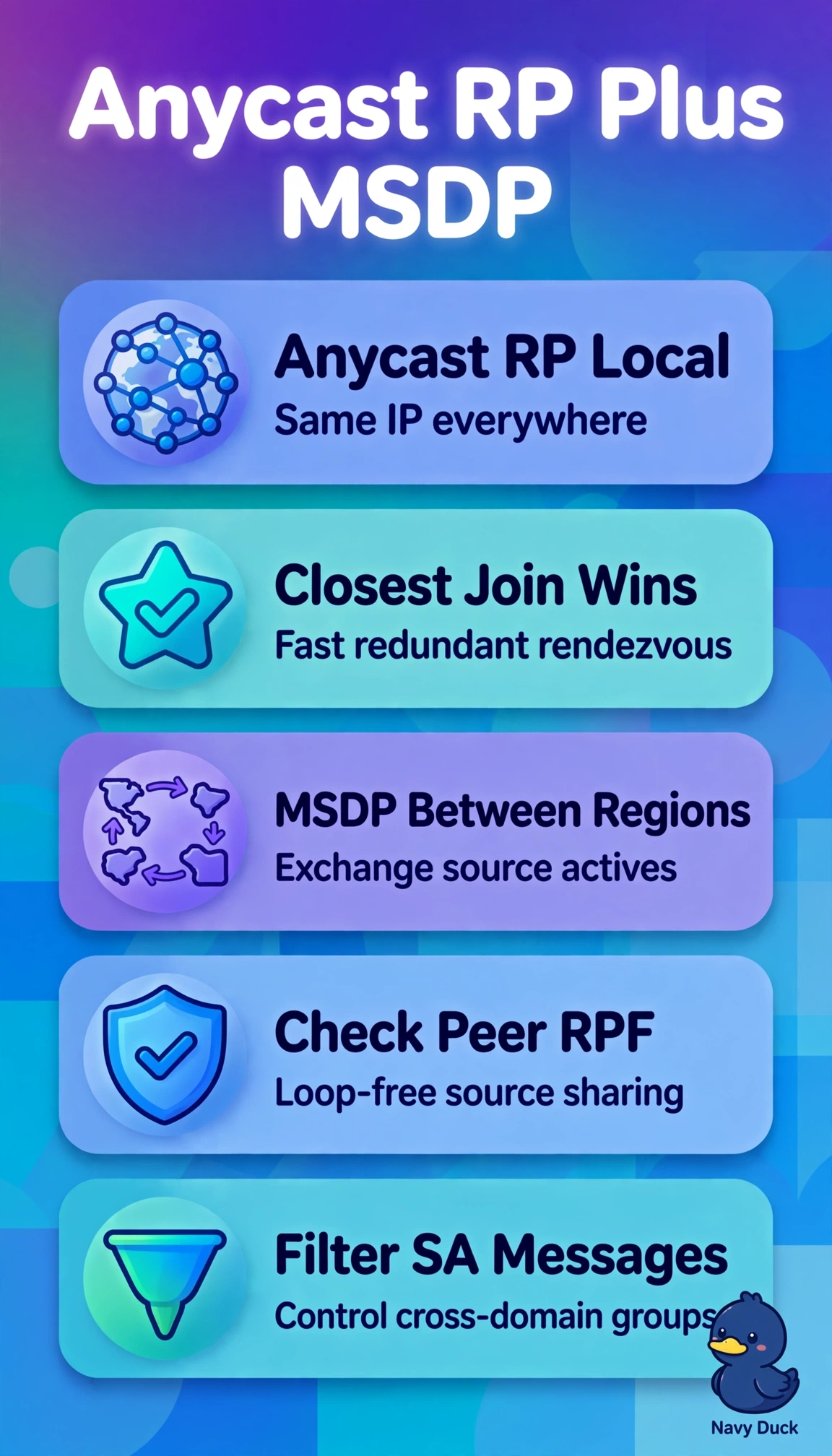
The correct design succeeds because anycast RP with the same RP address on multiple routers in a region plus MSDP between those peers synchronizes active source state and allows IGP failover for intra-region redundancy, while MSDP peering established between regions carries Source Active messages with peer-RPF checks so each domain learns remote sources redundantly without a single interconnect and without SA loops. The design that confines MSDP mesh groups and SA caching to peers inside each region improves local SA flooding control and convergence but provides no inter-region SA exchange, so receivers cannot discover sources in the other region despite healthy local RPs. The design based on static RP addressing with MSDP peering and SA filtering does exchange sources across regions with loop prevention but maps each region to one operative router, so failure of that router stops new group-to-RP registration and violates the intra-region redundancy that anycast is intended to provide. The design that advertises sources via MBGP to avoid MSDP complexity provides interdomain multicast topology and RPF information but MBGP carries reachability rather than active source state, so remote PIM-SM domains never create the required source-triggered state and interdomain discovery fails. For exams, distinguish reachability from discovery: MBGP, filtering, and mesh-group tuning help loop-free routing and scaling but only interdomain MSDP SA exchange with RPF creates loop-free source knowledge, and local tuning never substitutes for missing peering. In practice, verify with show ip pim rp mapping confirming the anycast address on multiple routers, show ip msdp peer and summary showing Established sessions to both local and remote peers, and show ip msdp sa-cache confirming remote groups appear when traffic is sourced.