
A retail IS-IS network has Level 1 stores, Level 2 core, excessive leaking causing large store tables, inconsistent metrics after migration, and need for 10 aggregate routes at borders. Stability is the goal. Which IS-IS route leaking, summarization and metric style combination best stabilizes this hierarchy?
Select an answer to reveal the explanation.
Short Explanation
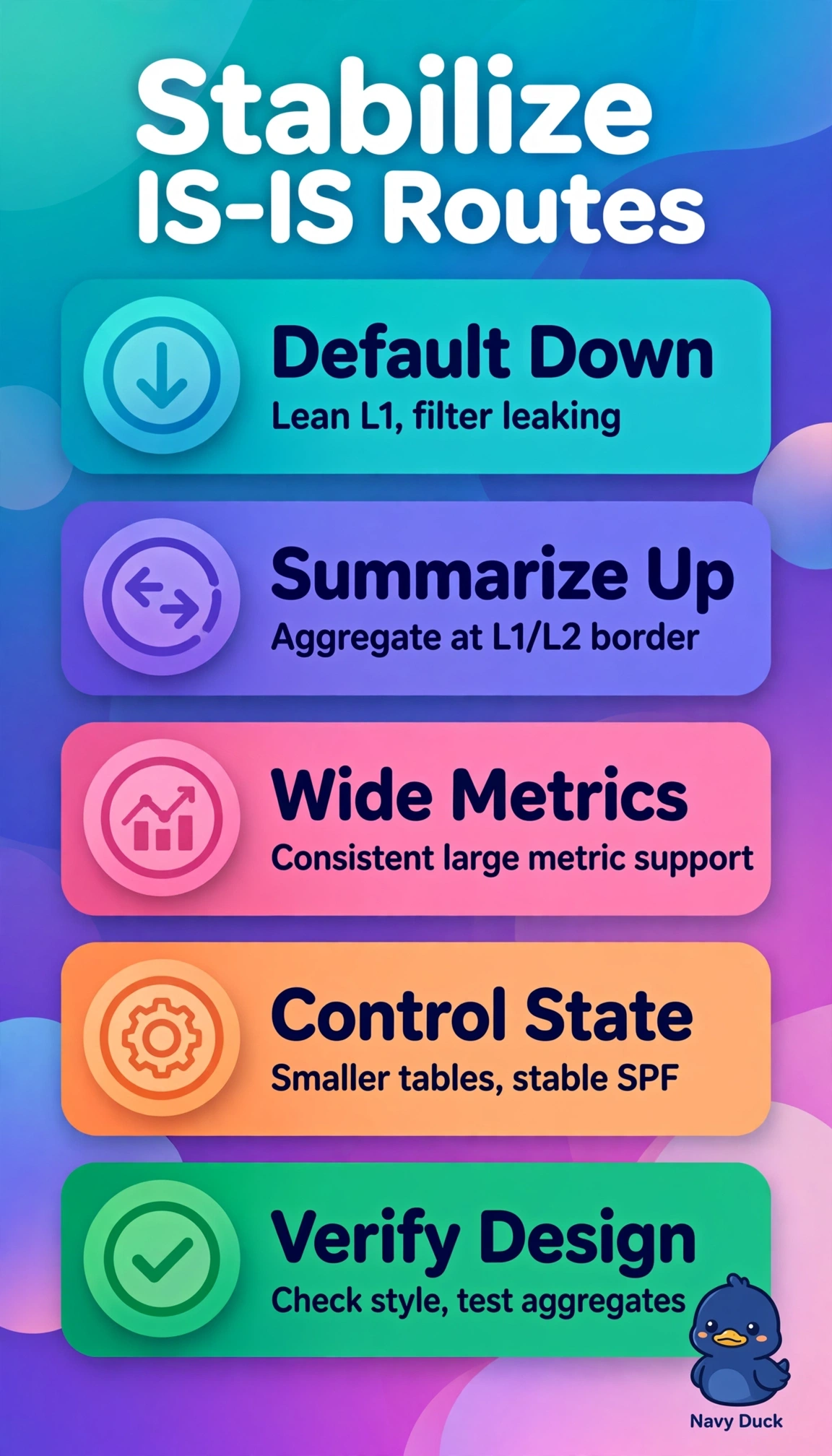
You'll help your stores stay lean by leaking only defaults down, like handing them a single road sign instead of a whole atlas. You'll then summarize at the borders and stick with wide metrics everywhere so things stay stable.
Full Explanation
The correct combination stabilizes the hierarchy because filtering Level 2 to Level 1 leaking to a default keeps store Level 1 tables minimal while preserving core reachability, summarization at L1/L2 borders replaces many site prefixes with the required 10 aggregates and limits LSP flooding and SPF work, and consistent wide metrics provide large metric space and modern sub-TLV support that resolve post-migration inconsistency. The selective leaking choice fails by route-leaking concept because even a controlled set of Level 2 prefixes reintroduces excess state into Level 1 and defeats the default-only design needed to fix large store tables where stability outweighs optimality. The internal summarization choice fails by aggregation-placement concept because summarizing on Level 1 internal routers hides detail in the wrong place and does not constrain advertisements across the L1/L2 boundary where the aggregates must be created. The narrow-metric choice fails by metric concept because narrow metrics allow only small interface and path costs and lack wide-metric extensions, so retaining them perpetuates inconsistency and limits scalability. As an exam caveat, remember IS-IS naturally advertises Level 1 routes into Level 2 but does not leak Level 2 into Level 1 unless configured, so distinguish attached defaults from explicit leaking. As a practical check, verify wide metrics on all IS-IS interfaces and confirm store tables contain only local Level 1 routes plus defaults while border routers advertise exactly the planned aggregates.