
A logistics firm with 60 sites needs any-to-any connectivity, fast new-site turn-up, and minimal in-house routing operations while retaining control of internal address planning. Which Layer 2 VPN versus MPLS Layer 3 VPN choice fits routing ownership and scaling?
Select an answer to reveal the explanation.
Short Explanation
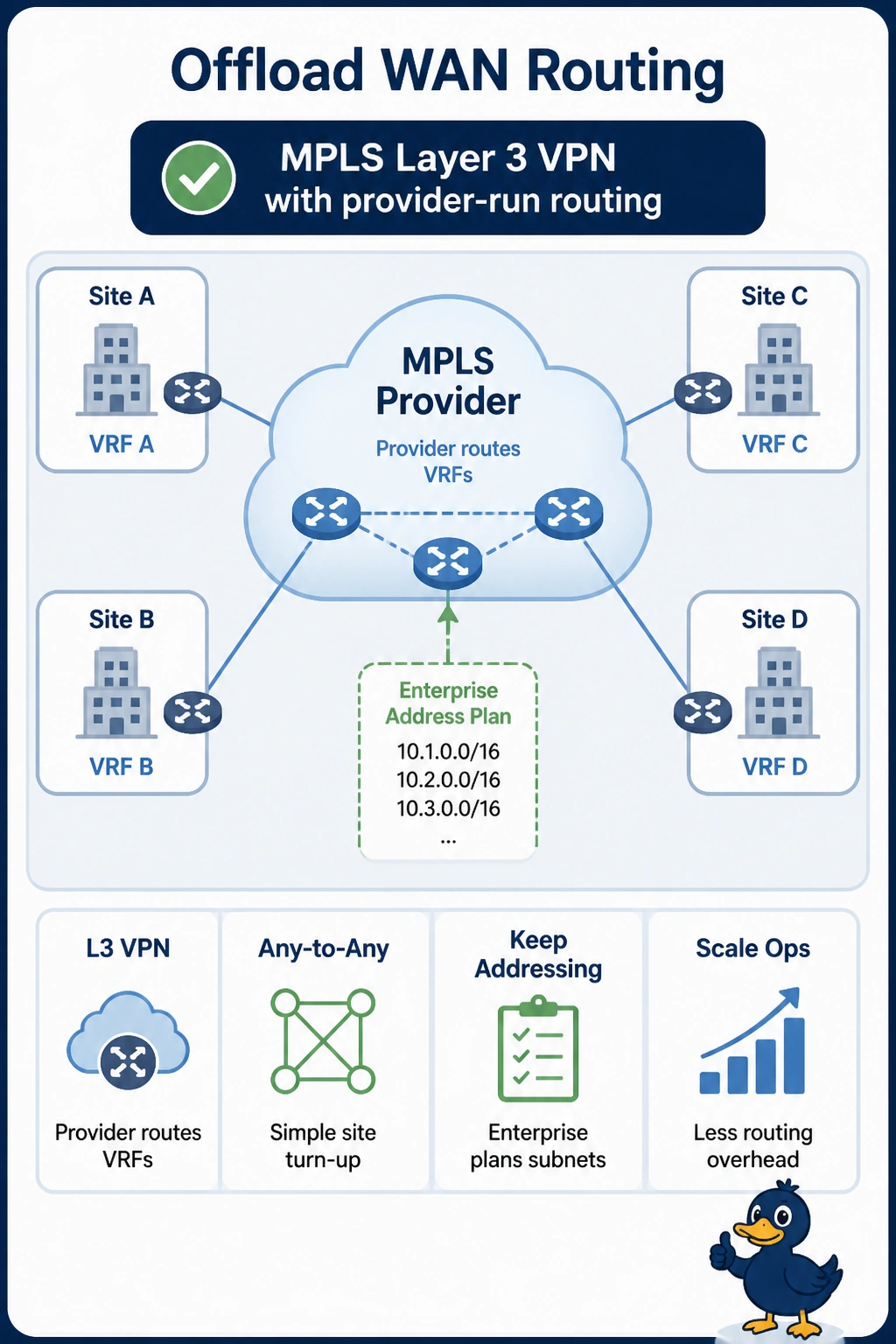
Hand the routing headaches to the provider cloud so new sites just plug in. Provider-managed routing scales any-to-any without growing your ops team.
Full Explanation
The MPLS Layer 3 VPN with provider routing fits because provider edge routers carry customer VRFs and exchange routes via MP-BGP, so any-to-any reachability is achieved without enterprise mesh configuration and a new site needs only a single CE-PE peering to gain full connectivity, which enables fast turn-up at sixty-site scale while the enterprise retains control of internal address planning by originating its own prefixes across the peering policy and offloads core routing operations. The VPLS multipoint concept fails on routing ownership because a transparent Layer 2 service bridges Ethernet across the WAN but leaves all IP adjacency, optimal path selection, and broadcast containment to customer routers, increasing in-house operations and MAC scale risk at this size rather than minimizing them. The provider-assigned addressing variant fails on address control because allowing the provider to dictate private prefixes removes enterprise authority over summarization, overlap avoidance, and merger flexibility, even though it preserves provider routing and scaling benefits. The Internet DMVPN mesh concept fails on operational burden because while NHRP plus IPsec creates dynamic any-to-any tunnels with rapid deployment and preserves addressing, the enterprise must still design, secure, monitor, and troubleshoot tunnel endpoints and dynamic routing at every site, contradicting minimal operations. The exam caveat is to separate transport from control plane: Layer 2 VPN extends broadcast domain while Layer 3 VPN distributes routes, so questions about who manages routing point to Layer 3 even when Layer 2 appears to simplify addressing. The practical check is to validate the statement of work for PE-CE protocol, VRF route-target design, prefix-ownership boundaries, and turn-up responsibilities before committing.