
A campus core with dual supervisors must survive a supervisor switchover without dropping OSPF and BGP neighbors or triggering reconvergence during business hours. Stateful failover and protocol continuity are mandatory. Which graceful restart with NSF and SSO design meets the hitless failover requirement?
Select an answer to reveal the explanation.
Short Explanation
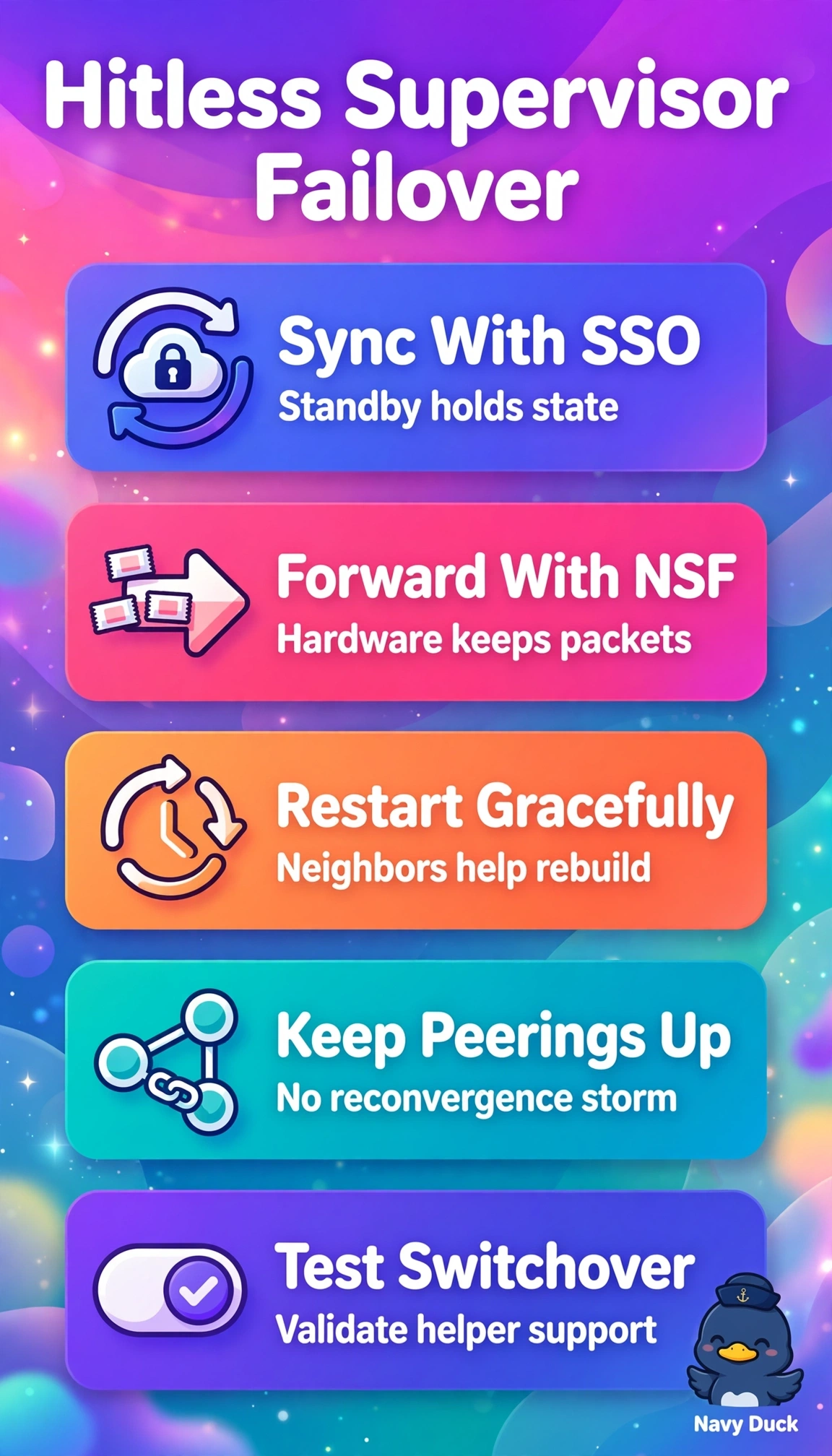
You'll keep your neighbors from noticing the swap with NSF with SSO, like a relay runner passing the baton without breaking stride while the control plane catches up. Your forwarding stays up, so you won't trigger any reconvergence during business hours.
Full Explanation
The correct design succeeds because SSO synchronizes system and protocol state to the standby supervisor for stateful switchover in seconds, while NSF with IETF graceful restart signals neighbors to preserve forwarding and hold adjacencies during control-plane recovery, requiring both OSPF and BGP graceful restart negotiation so neither neighbor drops nor reconverges during business hours. The OSPF-only graceful restart design fails on multiprotocol continuity because BGP without graceful restart expires hold timers, resets TCP sessions, and forces best-path recomputation with traffic impact despite stable OSPF forwarding. The BGP-only graceful restart design fails symmetrically because OSPF without restarting and helper support tears down adjacencies, floods LSAs, and runs SPF, triggering campus reconvergence even though BGP remains stable. The RPR-based redundancy design fails on statefulness because Route Processor Redundancy does not synchronize state like SSO, forcing the new active to reinitialize protocols and rebuild RIB and FIB even with NSF helpers, causing interruption. Exam caveat is to verify both restart and helper roles plus address families are configured, since enabling SSO alone does not auto-enable graceful restart for OSPF and BGP. Practical check is to verify SSO active via redundancy status, confirm graceful-restart capabilities for OSPF and BGP neighbors, then perform a lab force-switchover while watching neighbor uptime and forwarding counters for zero loss.